Passenger Presence System Indicator Circuit Malfunction
Passenger Presence System Indicator Circuit Malfunction
Diagnostic Instructions
* Perform the Diagnostic System Check - Vehicle (Initial Inspection and Diagnostic Overview) prior to using this diagnostic procedure.
* Review Strategy Based Diagnosis (Initial Inspection and Diagnostic Overview) for an overview of the diagnostic approach.
* Diagnostic Procedure Instructions (Initial Inspection and Diagnostic Overview) provides an overview of each diagnostic category.
Diagnostic Fault Information
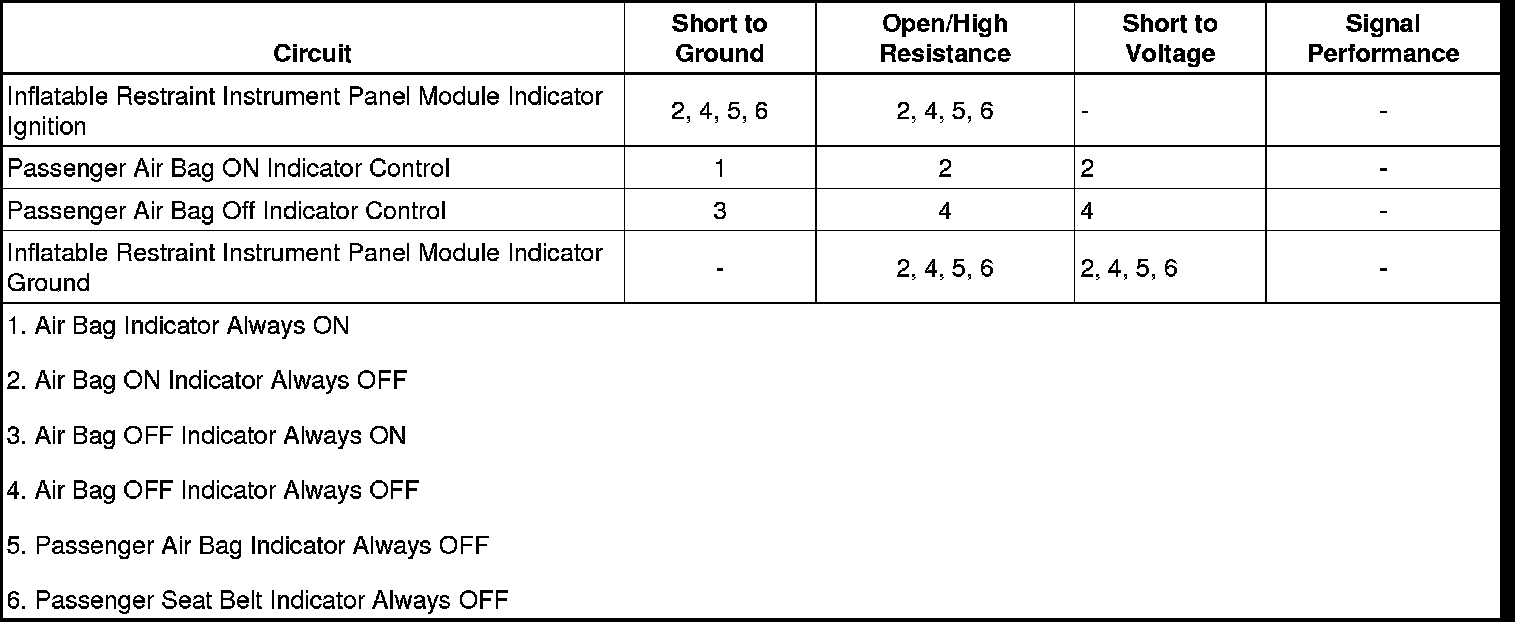
Circuit/System Description
The PASSENGER AIR BAG ON/OFF indicators are used to notify the driver when the passenger presence system (PPS) has enabled or disabled the instrument panel (I/P) inflator module. When the ignition is turned ON, the PPS module is supplied with voltage and commands both PASSENGER AIR BAG ON/OFF indicators ON for 5 seconds; then the PPS module conducts tests on the PPS components and circuits while both PASSENGER AIR BAG ON/OFF indicators are ON. If no malfunctions are detected, the PPS module will turn the PASSENGER AIR BAG indicator ON or OFF, depending on the status of the PPS. If a malfunction is detected, the PPS module will store a diagnostic trouble code (DTC), default the PPS to the OFF state, and communicate with the SDM that a DTC has been set. The SDM will request the instrument panel cluster (IPC) to turn the AIR BAG indicator ON to notify the driver of a PPS malfunction.
Diagnostic Aids
A history DTC maybe caused by an intermittent short or open in the ignition 1 circuit for the passenger AIR BAG ON/OFF indicator.
Reference Information
Schematic Reference
SIR Schematics ([1][2]Air Bag Systems)
Connector End View Reference
Component Connector End Views (Connector Views)
Description and Operation
SIR System Description and Operation (Description and Operation)
Electrical Information Reference
* Circuit Testing (Component Tests and General Diagnostics)
* Connector Repairs (Component Tests and General Diagnostics)
* Testing for Intermittent Conditions and Poor Connections (Component Tests and General Diagnostics)
* Wiring Repairs (Component Tests and General Diagnostics)
Scan Tool Reference
Control Module References (Programming and Relearning) for scan tool information
Circuit/System Verification
With the passenger seat occupied and unoccupied the inflatable restraint passenger air bag ON/OFF indicator should switch states within 5 seconds.
Circuit/System Testing
Important: When removing connectors inspect for damage or corrosion. Damage or corrosion in the following requires repair or replacement of the affected component/connector.
* The Passenger AIR BAG ON/OFF indicator
* The PPS module
* The Passenger AIR BAG ON/OFF indicator wiring harness connector
* The PPS wiring harness connector
1. Ignition OFF, disconnect the harness connector at the inflatable restraint passenger air bag on/off indicator.
2. Test for less than 1 ohm between the ground circuit terminal 2 and ground.
• If greater than the specified range, test the ground circuit for an open/high resistance.
3. Ignition ON, verify that a test lamp illuminates between the ignition circuit terminal 4 and ground.
• If the test lamp does not illuminate, test the ignition circuit for a short to ground or an open/high resistance, if the circuit tests normal and the ignition fuse is open, test or replace the inflatable restraint passenger air bag on/off indicator.
4. With the right front passenger seat occupied, verify that a test lamp illuminates between the control circuit terminal 1 and B+.
• If the test lamp does not illuminate, test the control circuit for a short to voltage or an open/high resistance. If the circuit tests normal, replace the PPS module.
5. With the right front passenger seat vacant, verify that a test lamp does not illuminate between the control circuit terminal 1 and B+.
• If the test lamp illuminates, test the control circuit for a short to ground. If the circuit tests normal, replace the PPS module.
6. With the right front passenger seat vacant, verify that a test lamp illuminates between the control circuit terminal 3 and B+.
• If the test lamp does not illuminate, test the control circuit for a short to voltage or an open/high resistance. If the circuit tests normal, replace the PPS module.
7. With the right front passenger seat occupied, verify that a test lamp does not illuminate between the control circuit terminal 3 and B+.
• If the test lamp illuminates, test the control circuit for a short to ground. If the circuit tests normal, replace the PPS module.
8. If all circuits test normal, test or replace the inflatable restraint passenger air bag on/off indicator.
Component Testing
1. Ignition OFF, disconnect the harness connector at the inflatable restraint passenger air bag on/off indicator.
2. Install a 2-amp fused jumper wire between the ignition terminal 4 and 12 volts. Momentarily install a jumper wire between the control terminal 1 and ground. Verify the ON indicator illuminates.
• If the ON indicator does not illuminate, replace the inflatable restraint instrument panel module indicator.
3. Install a 2-amp fused jumper wire between the ignition terminal 4 and 12 volts. Momentarily install a jumper wire between the control terminal 3 and ground. Verify the OFF indicator illuminates.
• If the OFF indicator does not illuminate, replace inflatable restraint instrument panel module indicator.
Repair Instructions
Perform the Diagnostic Repair Verification (Verification Tests) after completing the diagnostic procedure.
* Inflatable Restraint Instrument Panel Module Indicator Replacement (Service and Repair)
* SIR/SRS Wiring Repairs (Component Tests and General Diagnostics)
* Control Module References (Programming and Relearning) for PPS replacement, setup, and programming