Engine Coolant Temperature Sensor, Checking
Engine Coolant Temperature Sensor, Checking
CAUTION!
• Cooling system is under pressure.
• Danger of scalding when opening!
• Use only gold-plated terminals when servicing terminals in the electrical harness connector of Engine Coolant Temperature (ECT) Sensor (G62).
Special tools, testers and auxiliary items required
• Multimeter.
• Wiring diagram.
Test requirements
• The Engine Control Module (ECM) (J623) fuses OK.
• Battery voltage at least 12.5 V.
• All electrical consumers such as, lights and rear window defroster, switched off.
• Vehicles with automatic transmission, shift selector lever into position "P" or "N".
• A/C switched off.
• Ground (GND) connections between engine/transmission/chassis OK.
• Ignition switched off.
• Engine cold.
Test procedure
- Perform a preliminary check to verify the customer's complaint. Refer to => [ Preliminary Check ] Preliminary Check.
- Connect the scan tool.
- Switch the ignition on.
- Using the scan tool, check the coolant temperature:

• If a temperature is indicated which differs greatly from the ambient temperature of the sensor, check the sensor and wiring for contact resistances and open circuits.
If the specified value is obtained:
- Start the engine and let it run at idle.
The temperature value must increase uniformly in increments of 10 °C.
• If the engine shows problems in certain temperature ranges and if the temperature does not climb uniformly, the temperature signal is intermittent and the sensor should be replaced.
- Replace the the Engine Coolant Temperature (ECT) Sensor (G62).
- End diagnosis and switch the ignition off.
If the indications do not resemble description:
Checking internal resistance
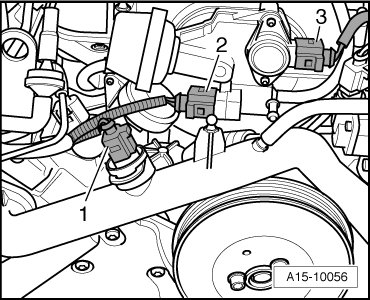
- Disconnect electrical harness connector - 1 - from the Engine Coolant Temperature (ECT) Sensor (G62).
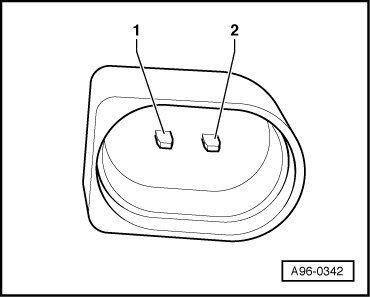
- Using a multimeter, check the Engine Coolant Temperature (ECT) Sensor (G62) for resistance between terminals - 1 -and - 2 -.
Specified value: 450 to 1000 ohms.
If specified value is not obtained:
- Replace the the Engine Coolant Temperature (ECT) Sensor (G62).
If specified value is obtained:
Checking voltage
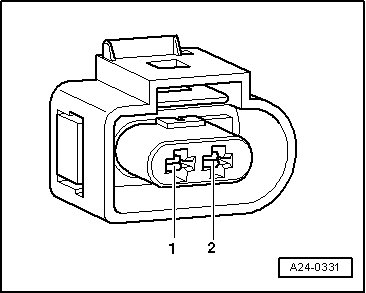
- Using a Multimeter , check the Engine Coolant Temperature (ECT) Sensor (G62) electrical harness connector for voltage.

Specified value: Battery voltage.
If specified value is obtained:
- Replace the Engine Coolant Temperature (ECT) Sensor (G62).
If the specified value was not obtained:
Checking wiring connections
If the manufacturers test box is being used, perform the following step.
- Connect the Test Box 105 Pin (VAG1598/42) with Adapter Cable (1598/39-1).
If the manufacturers test box is not being used, perform the following step.
- Remove the Engine Control Module (ECM) (J623) => [ Engine Control Module, Replacing ] Engine Control Module, Replacing.
- Using a Multimeter, check the Engine Coolant Temperature (ECT) Sensor (G62) electrical harness connector terminals to the Engine Control Module (ECM) (J623) electrical harness connector terminals for resistance.

Specified value: 1.5 ohms max.
If the specification is not obtained:
- Check the wiring for a short circuit to Battery positive (+) or an open circuit.
- If necessary, repair the wiring connection.
If no malfunctions are found in wires:
- Replace the Engine Control Module (ECM) (J623) => [ Engine Control Module, Replacing ] Engine Control Module, Replacing.
- Assembly is performed in the reverse of the removal.
After repair work, the following work steps must be performed in the following sequence:
1. Check the DTC memory. Refer to => [ Diagnostic Mode 03 - Read DTC Memory ] Diagnostic Mode 03 - Read DTC Memory.
2. If necessary, erase the DTC memory. Refer to => [ Diagnostic Mode 04 - Erase DTC Memory ] Diagnostic Mode 04 - Erase DTC Memory.
3. If the DTC memory was erased, generate readiness code. Refer to => [ Readiness Code ] Monitors, Trips, Drive Cycles and Readiness Codes.