Brake Caliper Replacement - Front
Brake Caliper Replacement- FrontCaution: Refer to Brake Dust Caution.
Brake Dust Caution
Caution: Refer to Brake Fluid Irritant Caution.
Brake Fluid Irritant Caution
Notice: Refer to Brake Fluid Effects on Paint and Electrical Components Notice.
Brake Fluid Effects on Paint and Electrical Components Notice
Removal Procedure
1. Inspect the fluid level in the brake master cylinder reservoir.
2. If the brake fluid level is midway between the maximum-full point and the minimum allowable level, no brake fluid needs to be removed from the reservoir before proceeding.
3. If the brake fluid level is higher than midway between the maximum-full point and the minimum allowable level, remove brake fluid to the midway point before proceeding.
4. Raise the vehicle and suitably support. Refer to Vehicle Lifting.
5. Mark the relationship of wheel to the axle flange.
6. Remove the tire and wheel assembly.
7. Hand tighten 2 wheel lug nuts to retain the rotor to the hub.
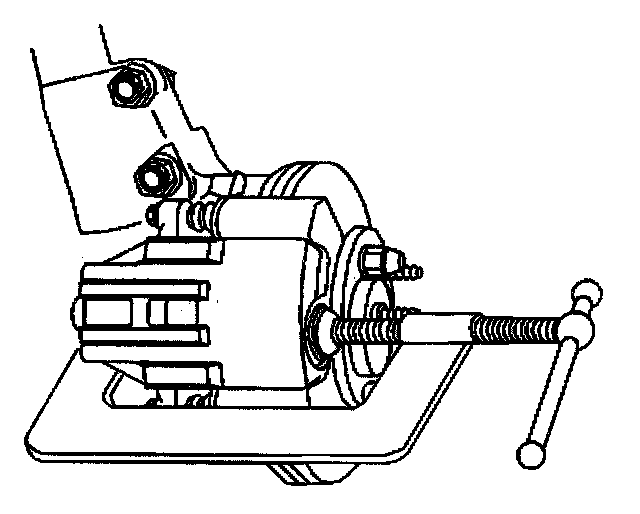
8. Install a large C-clamp over the body of the brake caliper with the C-clamp ends against the rear of the caliper body and against the outer brake pad.
9. Tighten the C-clamp until the caliper piston is compressed into the caliper bore enough to allow the caliper to slide past the brake rotor.
10. Remove the C-clamp from the caliper.
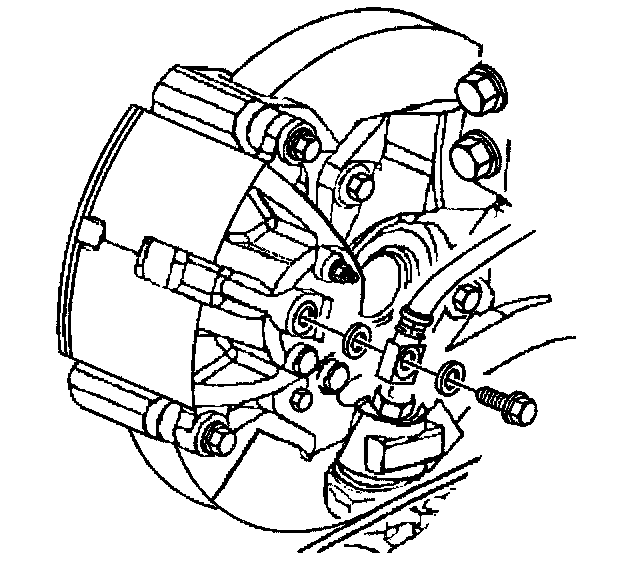
11. Remove the brake caliper inlet fitting bolt to the brake caliper.
12. Remove and discard the two copper brake hose gaskets. These gaskets may be stuck to the brake caliper and/or the brake hose end.
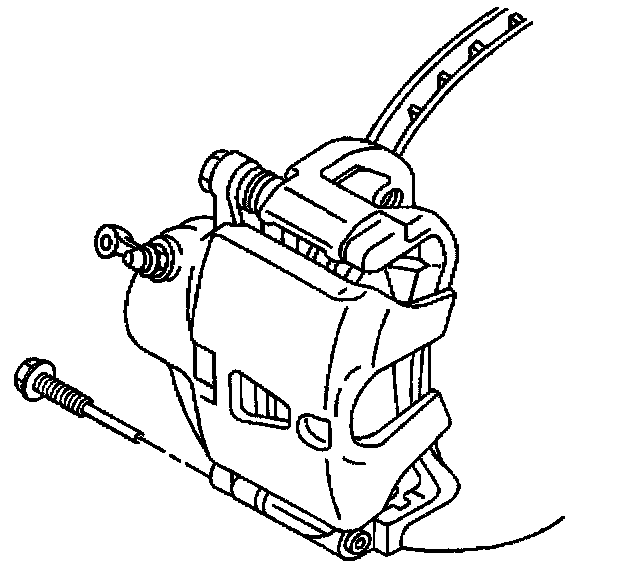
13. Plug the opening in the brake caliper and brake hose to prevent fluid loss and contamination.
Important: When servicing the brake caliper, the first design hardware will be upgraded to the second design hardware, with new caliper pin bolts.
14. Remove the brake caliper pin bolts.
15. Remove the brake caliper.
Installation Procedure
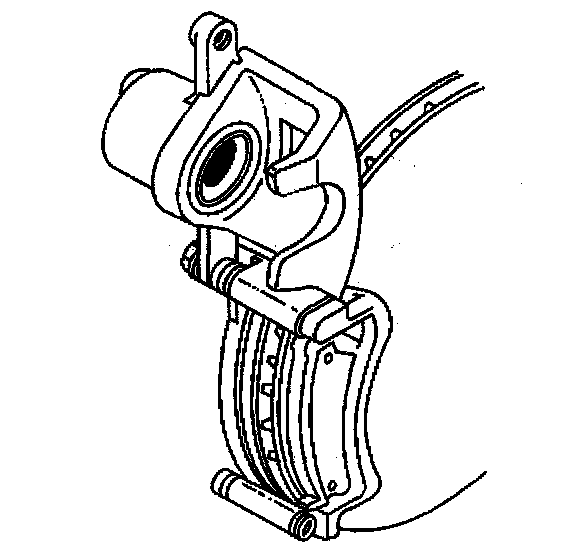
1. If reusing the brake caliper pin bolts and retainers, clean the brake caliper pin bolts and retainers using denatured alcohol, or equivalent.
2. Dry the brake caliper pin bolts and retainers, using non-lubricated, filtered air.
Important: DO NOT apply lubricant to the brake pad hardware.
3. If using the first design hardware apply high temperature silicone brake lubricant to the brake caliper pin bolts and retainers. If using the second design hardware apply NIGLUBE. grease to the brake caliper pin bolts. It is not necessary to apply lubricant to the brake pad hardware or the threads of the pin bolts.
4. Install the brake caliper over the brake pads into the brake caliper bracket.
Notice: Refer to Fastener Notice in Service Precautions.
Fastener Notice
Important: If installing the second design hardware kit the upper caliper pin bolt, has a bushing as part of the assembly. The lower caliper pin, is a solid design pin bolt.
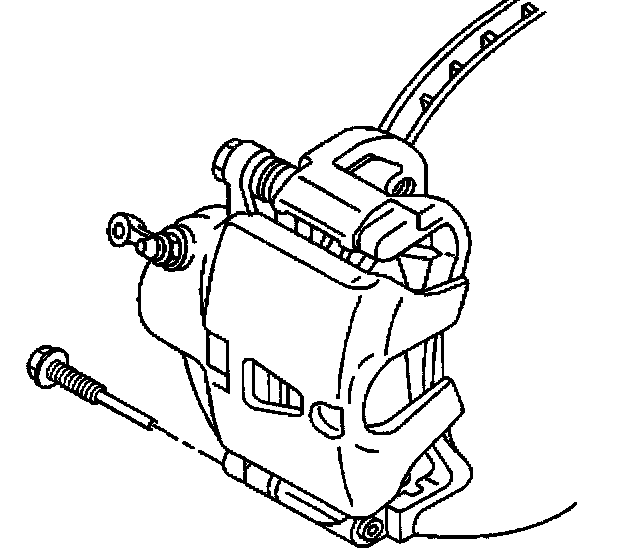
5. Install the brake caliper pin bolts.
- Tighten the brake caliper pin bolts to 85 Nm (63 lb ft).
Important: Install NEW copper brake hose gaskets.
6. Assemble the brake hose bolt and the NEW copper brake hose gaskets to the brake hose.
7. Install the brake caliper inlet fitting bolt to the brake caliper.
- Tighten the brake caliper inlet fitting bolt to 45 Nm (33 lb ft).
8. Bleed the brake system.
9. With the engine OFF, gradually apply the brake pedal to approximately 2/3 of its travel distance.
10. Slowly release the brake pedal.
11. Wait 15 seconds, then repeat steps 14-15 until a firm brake pedal apply is obtained. This will properly seat the brake caliper pistons and brake pads.
12. Remove the 2 wheel lug nuts retaining the rotor to the hub.
13. Install the tire and wheel assembly.
14. Lower the vehicle.