Pressure
CAUTIONS:^ Pressure bleeding equipment must be the diaphragm type and must have a rubber diaphragm between the air supply and the brake fluid to prevent air, moisture, oil and other contaminants from entering the hydraulic system.
^ It is very important that the correct master cylinder bleeder adapters be used to avoid possible damage to the master cylinder reservoirs.
Installing Bleeder To Master Cylinder:
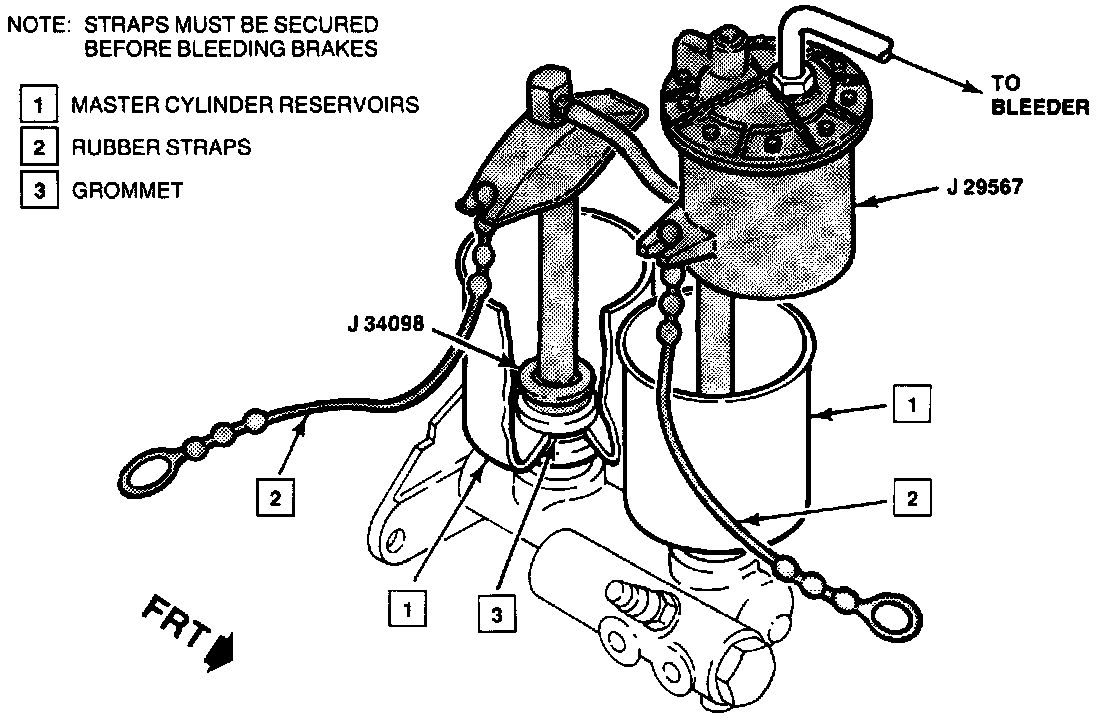
1. Connect J-34098 and J-29567 to master cylinder reservoirs.
2. Charge bleeder J-29532 to 20-25 PSI (140-173 kPa).
3. Connect hose to J-29567 and open the valve on the brake bleeder tank. Depress bleed-off valve on top of the adapter until a few drops of fluid appear.
4. Raise car.
5. If is is necessary to bleed all of the calipers the following sequence should be followed.
a. Right front
b. Right rear
c. Left rear
d. Left front
6. Place a proper size box end wrench over the bleeder valve. Attach a clear tube over valve and allow tube to hang submerged in a clear container partially filled with brake fluid.
7. Open the bleeder valves at least 3/4 turn and allow flow to continue until no air is seen in the fluid.
NOTE: Stroke brake pedal while pressure bleeding.
8. Close the bleeder valves.
NOTE: Be sure the bleeder valves seal.
9. Repeat steps 6 through 8 until all calipers have been bled.
10. Lower car.
11. Check the brake pedal for "sponginess" and the "BRAKE" warning lamp for indication of unbalanced pressure.
NOTE: Repeat entire bleeding procedure to correct either of these two conditions.
12. Remove brake bleeding equipment from master cylinder.