Central Control Module (CCM)
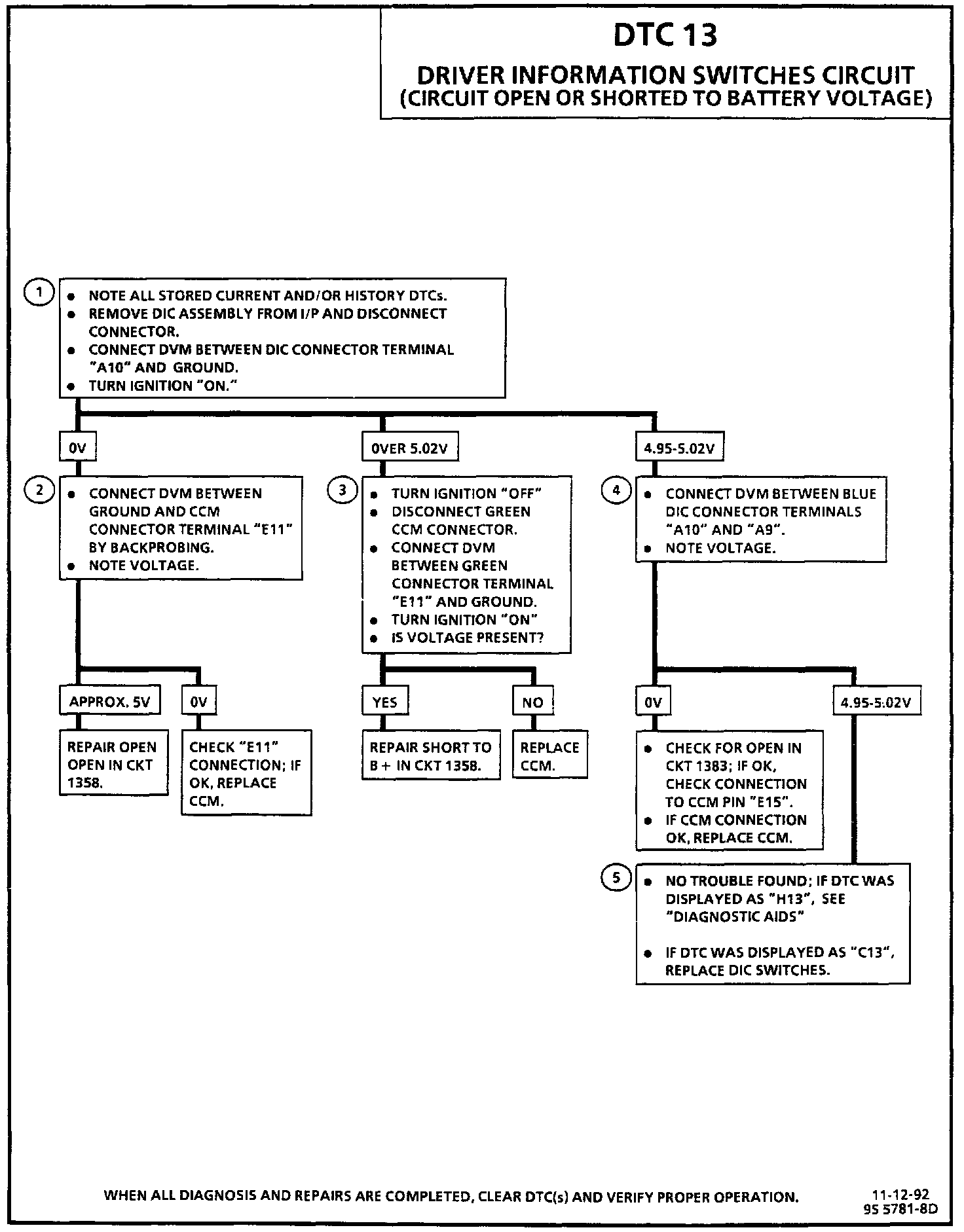
Diagnostic Chart:
Wiring Diagram:
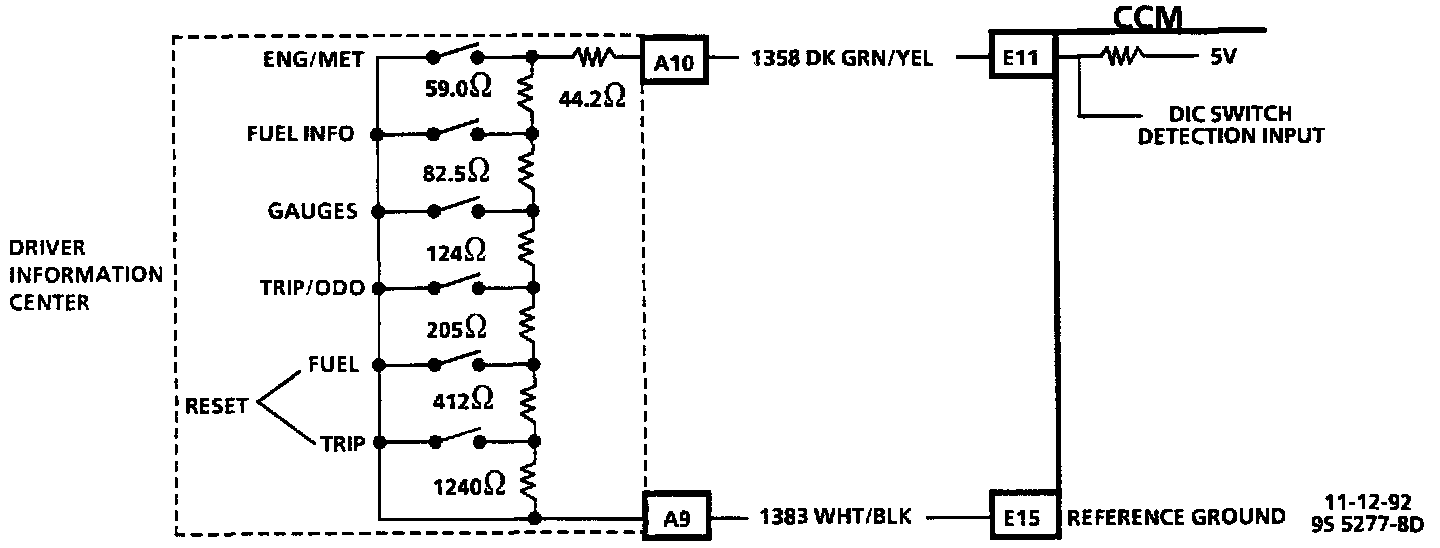
CIRCUIT DESCRIPTION
The Driver Information Center (DIC) switches circuit contains a number of resistors. When a particular switch is pressed, this selects a specific resistance value since the circuit current passes through only some of the resistors. By monitoring the output voltage from CCM terminal E11, the CCM determines which switch was pressed and performs the desired function.
If the CCM senses 5 volts (open) or more (short to B+) in CKT 1358 for more than 3 seconds, DTC 13 is set.
TEST DESCRIPTION
Number(s) below refer to circled number(s) on the diagnostic chart.
1. This test checks the voltage from CKT 1358 reaching the DIC switches circuit. If 0 volts. the circuit is open; if over 5.02 volts, the circuit has a short to B+; if 4.95-5.02 volts, the circuit is good up to that point.
2. This test checks to see if the CCM is malfunctioning or if the circuit is open. If the reading is approximately 5 volts, CKT 1358 between the CCM and the switches is open; if the reading is 0 volts, either the connection to the CCM is bad or the CCM is malfunctioning.
3. This test checks to see where the abnormally-high voltage is coming from. If voltage is measured, there is a short to B+ in CKT 1358; if no voltage is measured, there is an internal short in the CCM.
4. This test checks to see if the open is in the ground side (CKT 1383) or in the DIC switch assembly. If 0 volts is read, either CKT 1383 is open or its connection to the CCM is bad. If 4.95-5.02 volts is read, CKT 1383 is good.
5. If the DTC displayed was a current DTC (C13), the DIC switch assembly is open and should be replaced. If the DTC was a history DTC (H13), the malfunction may be intermittent. See "Diagnostic Aids."
DIAGNOSTIC AIDS
If the DTC is a history DTC, the problem may be intermittent. Try performing the tests shown while "wiggling" wiring and connectors; this can often cause the malfunction to appear. Check for poor connections at both the CCM and the DIC assembly; these could cause an open, short, or an intermittent malfunction. Refer to "Intermittents and Poor Connections" in DIAGRAMS.
If pressing a DIC switch does not give the desired result but performs another DIC switch function or no function at all, it is possible that the DIC switches are internally open or shorted. If a switch is shorted to B+, pressing it will send the wrong signal to the CCM, since the voltage added to the circuit from the short will confuse the CCM. If a switch is open, pressing it will give no result at all. Use the Tech 1 to monitor the DIC key A/D counts while pressing the keys.