Chart C-2C, Idle Air Control Valve Check
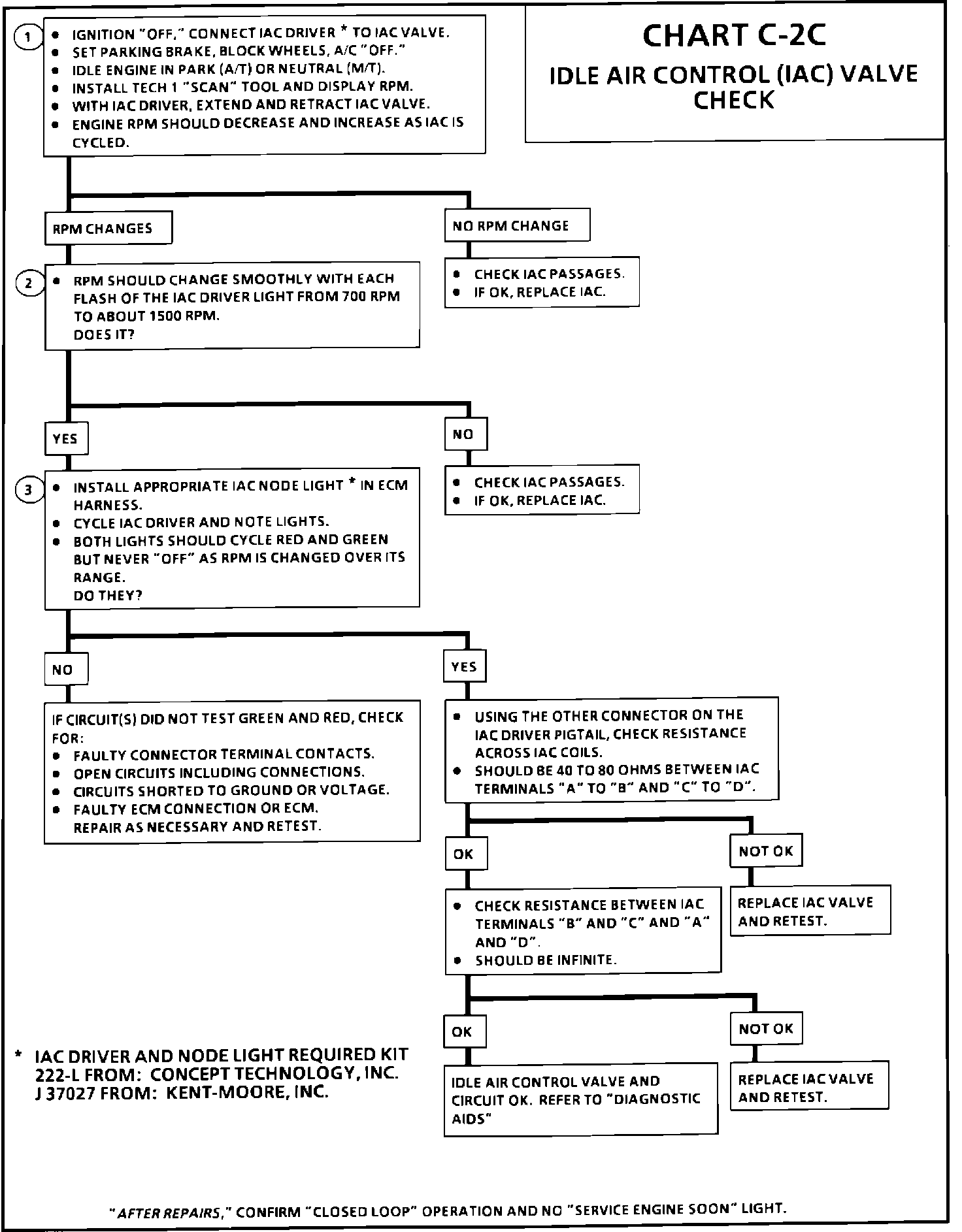
Chart C-2C, IAC Valve Check:
Idle Air Control (IAC) Circuit:
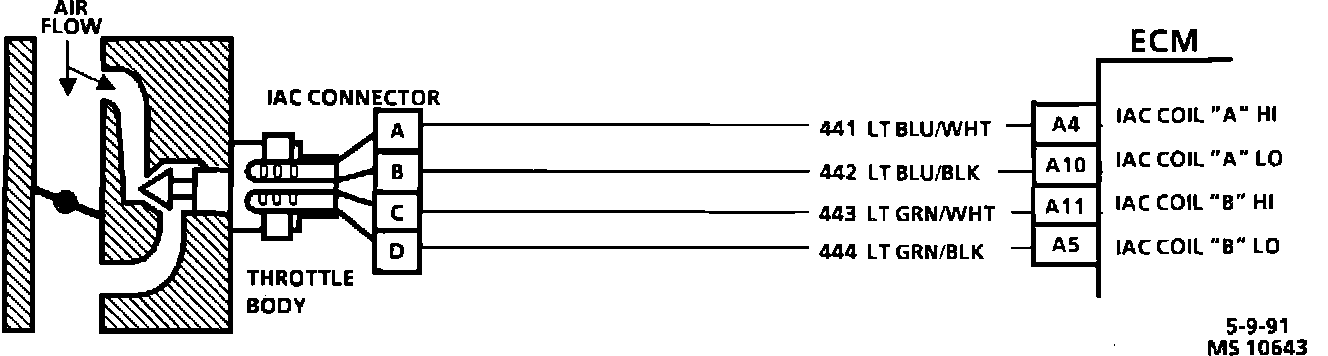
CIRCUIT DESCRIPTION
The PCM controls idle speed by moving the IAC valve pintle which opens and closes an air passage bypassing the throttle valve. A "SCAN" tool displays the commanded pintle position in counts. The greater the number of counts, the farther open the IAC valve is and the greater the commanded idle speed. IAC counts range from 0 (fully closed) to 255 (fully open.) Normal is between 15 - 20 counts.
NOTE: If the idle is oncorrect, first reset the IAC valve pintle position and see if problem goes away. To reset IAC valve, depress the accelerator slightly and start the engine. Hold the throttle steady while the engine runs for about 5 - 10 seconds, then turn engine "OFF" for 10 seconds. IAC valve position should be reset.
TEST DESCRIPTION
Numbers below refer to circled numbers on the diagnostic chart.
1. The IAC tester is used to extend and retract the IAC valve pintle. Pintle movement is verified by a change in engine idle speed. If no change in engine speed occurs, the valve can be removed from the throttle body and tested again. The movement can then be directly observed.
2. This step checks the quality of the IAC valve movement. Between 700 and about 1,500 rpm, the engine speed should change smoothly with each flash of the tester light in both retract and extend operations. If the valve pintle is retracted beyond its normal range of operation (engine speed about 1,500 rpm), no further change in engine speed will be noted (the diameter of the passage now being the limiting factor), and the tester may flash many times as the pintle is being extended, before a reduction in engine speed is noted. This is normal on many vehicles. Fully exending the pintle (completely closing the air passage) may cause the engine to stall. This also is normal for many vehicles.
3. Steps 1 and 2 verify proper IAC valve operation, while this step checks continuity of the wiring to the IAC valve, and checks the signal from the ECM. Each lamp on the node lights should flash red and green while the valve is being cycled, indicating a good circuit. While the sequence of flashes is not important, if either light fails to flash, or does not flash red AND green, check the circuits for faults. Look for poor connections, open circuits or shorts to ground.
DIAGNOSTIC AIDS
An idle speed that is too fast, too slow or unstable can be caused by other conditions that the IAC valve cannot compensate enough for.
NOTE: If the air intake to the engine is restricted (excessively dirty air filter), the PCM will attempt to compensate by retracting the IAC valve (increasing IAC counts), opening the air passage to maintain the desired idle speed. IAC counts may increase to greater than 60. If there is a vacuum leak or the throttle plates do not fully close, the PCM will try to compensate by extending the IAC pintle. IAC counts may be reduced to zero (air passage fully closed) as the PCM tries to reduce idle speed to the desired rpm.
ALSO CHECK
^ Vacuum Leak (high idle) - If the idle speed is too high, turn the engine "OFF", fully extend the IAC valve with the tester, and restart engine. If idle speed is still too high (greater than 800 rpm), check for vacuum leaks, including PCV system. Also check to make sure throttle is returning all the way to the closed throttle position and that closed throttle stop and air vent valve screw have not been tampered with.
^ System lean (High Air Fuel Ratio) - Idle speed may be too high or too low. Engine speed may vary up and down, disconnecting IAC does not help. May set Code 44. "Scan" and/or voltmeter will read an oxygen sensor output less than 300 mV (0.3 volt). Check for low regulated fuel pressure or water in fuel. A silicone contaminated oxygen sensor will show a false rich indication and cause the system to run the engine too lean. A lean exhaust, with an oxygen sensor output fixed above 800 mV (0.8 volt), or sensor output varying but fluctuating slowly, indicates a contaminated sensor. This may also set Code 45 &/or 65.
^ System rich (Low Air/Fuel Ratio) - Idle speed too low. "Scan" counts usually above 80. System obviously rich and may exhibit black smoke from exhaust. "Scan" tool or DVOM will read an oxygen sensor signal fixed above 800 mV (0.8 volt). Check for high fuel pressure or possibly an injector leaking or sticking. Also check EGR valve for leaking or sticking, and check EVAP system (charcoal canister saturated with fuel).
^ Throttle Body - Remove IAC and inspect bore for foreign material or evidence of IAC pintle dragging the bore.
^ IAC Valve connections - Check electrical connections carefully for proper contact.
^ PCV Valve - An incorrect or faulty PCV valve may cause incorrect or unstable idle.
^ A/C Compressor or Relay failure - If the A/C control relay drive circuit is shorted to ground, or if the relay is faulty, idle problems may result.
^ If unstable idle is cured by disconnecting IAC valve, carefully re-check valve and ECM connections, resistance through valve at connector terminals, and pintle for dragging against bore in throttle body.