Hydraulic Brake System Bleeding
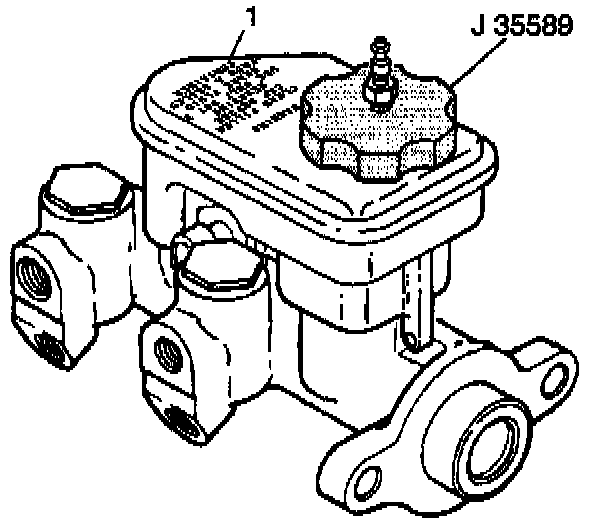
CAUTION: Do not move the vehicle anti/ a firm brake pedal is obtained. Air in the brake system can cause the loss of brakes with possible personal injury.
CAUTION: Use only SUPREME 11 (GM PN# 12377967) DOT 3 brake fluid from a clean, sealed container. Do not use fluid from a open container that may be contaminated with water. Improper or contaminated fluid could result in damage to components, or loss of braking, with possible injury.
CAUTION: Overfilling the reservoir must be avoided due to the potential for overflow onto the nearby catalytic converters in the exhaust system. Brake fluid is flammable, and contact with hot exhaust components could result in a fire and possible personal injury.
NOTICE: If any brake component is repaired or replaced such that air is allowed to enter the brake system, the entire bleeding procedure must be followed.
NOTICE: Avoid spilling brake fluid on any of the vehicle's painted surfaces, wiring, cables or electrical connectors. Brake fluid will damage paint and electrical connections. If any fluid is spilled on the vehicle, immediately flush the area with water to minimize the potential for damage.
NOTICE: Prior to bleeding the brakes, the front and rear displacement cylinder pistons must be returned to the topmost position. The preferred method uses a Scan Tool to perform the rehoming procedure. If a Scan Tool is not available, the second procedure may be used, but it is extremely important that the procedure be followed exactly as outlined.
A bleeding operation is necessary in order to remove air when air is introduced into the hydraulic brake system.
Bleed the hydraulic system at all four brakes if air has been introduced through a low fluid level or by disconnecting the brake pipes at the master cylinder. If a brake hose or brake pipe is disconnected at one wheel, bleed only that one wheel caliper. If brake pipes or hoses are disconnected at any fitting located between the master cylinder and the brakes, then bleed the brake system served by the disconnected pipe or hose.
WITH SCAN TOOL (PREFERRED METHOD)
1. Using a Scan Tool, select the Motor Rehome function. The motor rehome function cannot be performed if current DTCs are present. If DTCs are present, then repair the vehicle and clear the DTCs before performing the Motor Rehome function.
2. Bleed the entire brake system using either "Pressure Bleeding" or "Manual Bleeding".
WITHOUT SCAN TOOL
NOTICE: This method can only be used if the amber Antilock Brake System (ABS) warning indicator is not illuminated and no DTCs are present.
IMPORTANT: Do not place your foot on the brake pedal through this entire procedure unless specifically directed to do so.
1. Remove your foot from the brake pedal.
2. Start the engine. Allow the engine to run for at least 10 seconds while observing the amber ABS warning indicator.
3. If the amber ABS warning indicator turns on and stays on after about 10 seconds, stop the bleeding procedure and use a Scan Tool in order to diagnose the ABS malfunction.
4. If the amber ABS warning indicator turns on for approximately 3 seconds, then turns off and stays off, turn the ignition off.
5. Repeat Steps 1 through 4 one more time.
6. Bleed the entire brake system.