Runout Check
On vehicle rotor runout is the combination of the individual runout of the hub face and the runout of the rotor. (The hub and rotor runouts are separable). To measure runout on the vehicle:
1. Remove the wheel and reinstall the lug nuts tightening the rotor to the hub.
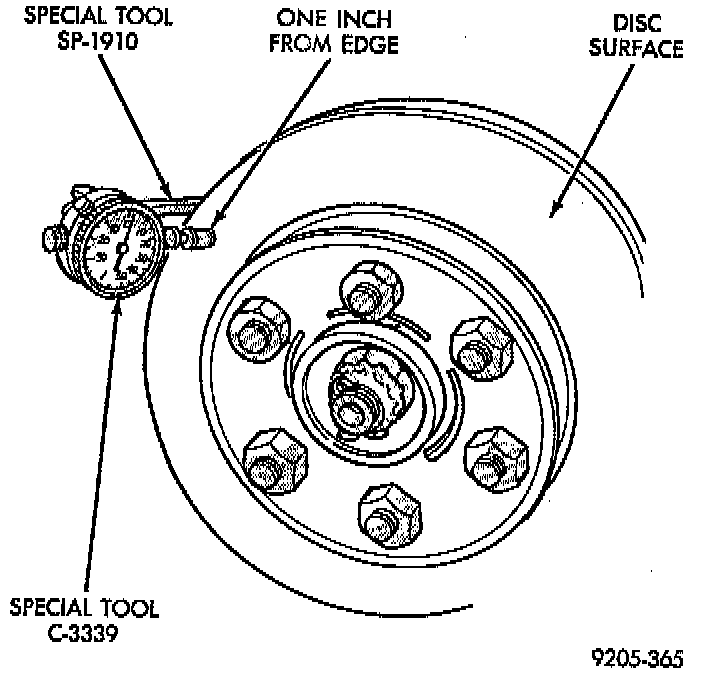
2. Mount Dial Indicator, Special Tool C-3339, or equivalent with Mounting Adapter, Special Tool SP-1910, or equivalent on steering arm.
3. Dial indicator plunger should contact braking surface of rotor approximately one inch from edge of rotor.
^ Check lateral runout (both sides of rotor) runout should not exceed 0.08mm (0.003 inch).
If runout is in excess of the specification, check the lateral runout of the hub face.
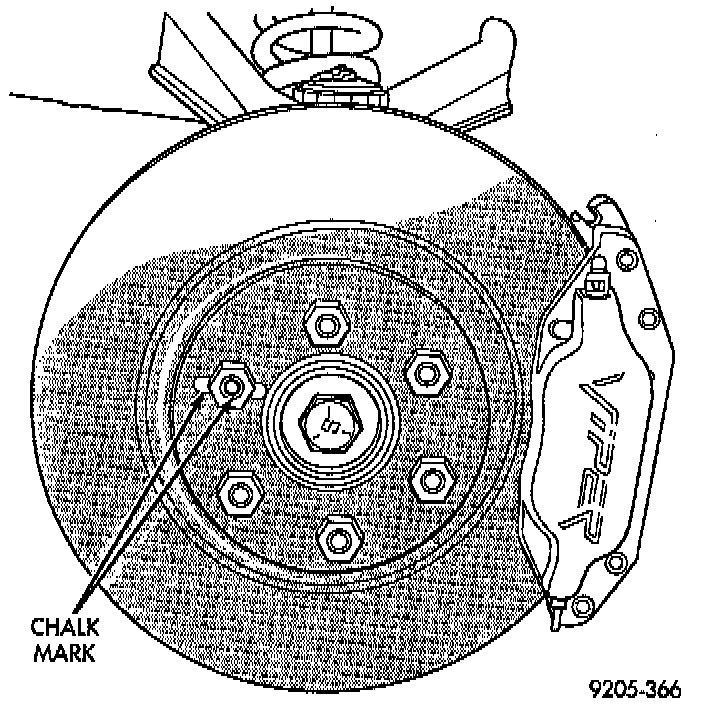
4. Before removing rotor from hub, make a chalk mark across both the rotor and one wheel stud on the high side of runout so you'll know exactly how the rotor and hub was originally mounted.
5. Remove the braking disc from the hub/bearing.
6. Install Dial Indicator, Special Tool C-3339, or equivalent and Mounting Adapter, Special Tool SP-1910, or equivalent on steering knuckle. Position stem so it contacts hub face near outer diameter. Care must be taken to position stem outside the stud circle but inside the chamfer on the hub rim.
7. Clean hub surface before checking.
8. Rotate the hub/bearing 1 full revolution 360° noting the minimum to maximum runout of the hub face.
^ Runout should not exceed 0.08 mm (0.003 inch).
If runout exceeds this specification, the hub/bearing must be replaced.
If hub runout does not exceed this specification, install rotor on hub with chalk marks two wheel studs apart.
9. Tighten the wheel lug nuts in the proper sequence and torque to specifications.
10. Finally, check runout of rotor to see if runout is now within specifications. If runout is not within specifications. Install a new rotor or reface rotor, being careful to remove as little as possible from each side of rotor. Remove equal amounts from each side of rotor. Do not reduce thickness below minimum thickness cast into the un-machined surface of the rotor.