(3)Cleaning Cooler Lines and Coolers
The following procedure for cleaning automatic transmission cooler lines should be adopted following any transmission running gear repair which may have resulted in loose foreign materials that can be deposited in the cooler tubes and hoses.1. Loosen hose clamps and clips and remove each auxiliary cooler hose.
2. Disassemble and remove the mounting bracket/clip attaching the cooler tubes to the engine and C-clips holding the tubes together.
3. Disassemble all cooler tube connections at the transmission and radiator and remove the cooler tubes, taking care not to bend them. To take tubes out of the plastic snail clips at the front, hold the clip and pull each tube sideways and down. Replace snail clips if they are damaged.
4. Flush out all the cooler tubes and hoses to remove all foreign materials by using a degreasing machine. Each tube can be connected to the fluid source by a piece of commercially available flexible hose if required. Hoses must not be soaked in the fluid.
5. Blow out each tube and hose with air to remove any remaining degreasing fluid.
6. Reinstall parts on vehicle, making sure that all clips, brackets, and connections are properly secured, and without bending the tubes.
6. Verify tube clearances to other components, especially the exhaust system. Also, verify correct position of hose clip and check that hoses are not kinked before running vehicles.
OTHER APPLICABLE ARTICLES: None
WARRANTY STATUS: Reimbursable within the provisions of the Warranty and Policy Manual
OPERATION: SP870216A
TIME: 1.0 Hr. DLR. CODING: Basic Part No. 7A030 - Code: 49
Transmission Cooler Cleaning/Replacement
Automatic transmissions which experience torque converter clutch plate failures may have foreign clutch plate friction materials released into the transmission fluid. These foreign materials may be captured by the transmission oil coolers and will recontaminate the fluid after the transmission has been replaced or repaired. These materials can also restrict the fluid flow to the new or repaired transmission.
Figure 19:
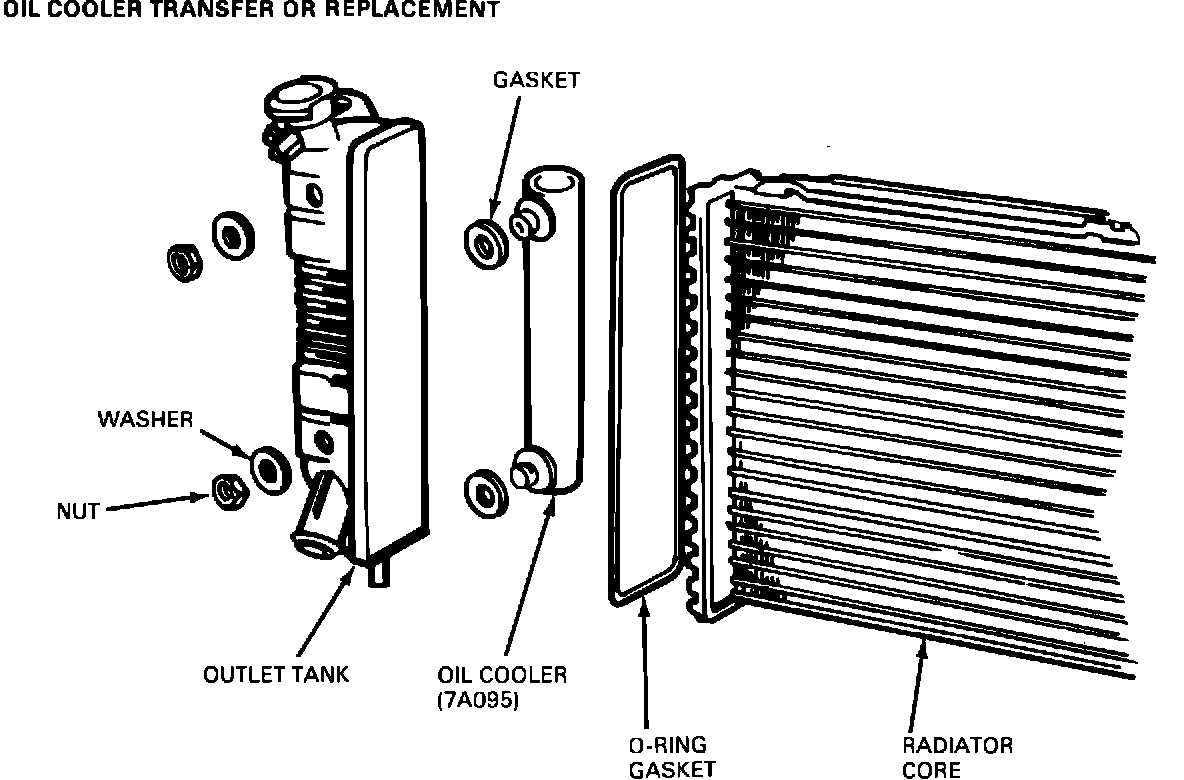
Figure 20:
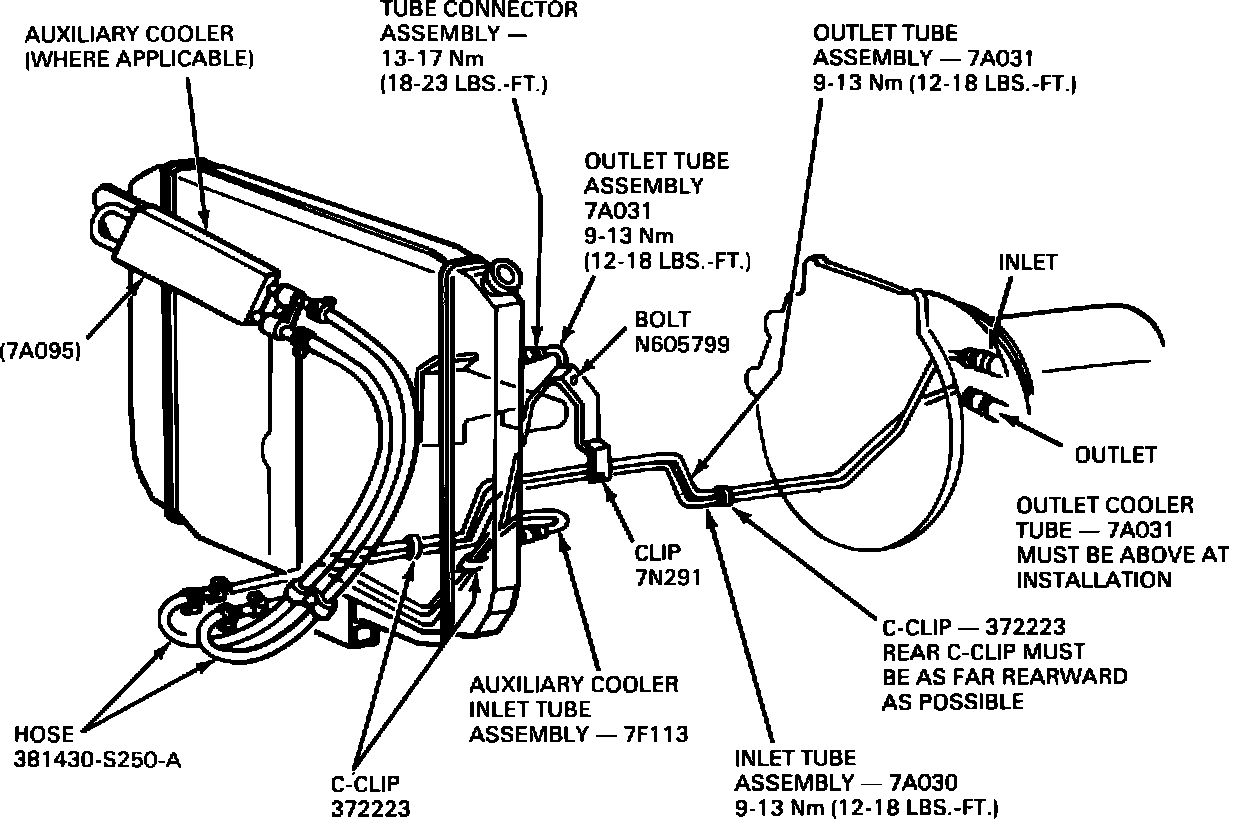
The cooler systems on all A4LD transmissions built prior to July 27, 1986 (date code 06G27) that have torque converter failures must be examined for foreign materials. To determine if clutch plate material has "flaked or broken away" and contaminated the system, the following methods should be used instead of cutting open the torque converter, (refer to Figures 19 and 20).
^ Drain the original torque converter fluid through filter paper and examine residue for any brownish soft-textured friction plate material, or
^ During flushing of fluid cooler lines and coolers, look for brownish clumps of soft-textured friction material in the solvent flow, or
^ Disconnect cooler lines and oil cooler fittings from both radiator in-tank openings (as outlined in the Shop Manual) and inspect the inlet and outlet openings for brownish clumps of softtextured friction material in either opening.
If any of the above conditions are noted, then the internal (radiator tank) transmission oil cooler (7A095) and the auxiliary transmission oil cooler (7A095), if present, must be removed and replaced with new parts, as described in Section 8-02 in the Aerostar Shop Manual and Section 27-04 in the Ranger/Bronco II Shop Manual.
PART NUMBER PART NAME CLASS
E4TZ-7A095-A Auxiliary Cooler Std. - CG
Ranger/Bronco II
E6TZ-7A095-A Auxiliary Cooler X-tra - C
Ranger/Bronco II
E69Z-7A095-A Auxiliary Cooler - C
Aerostar
E5TZ-7A095-D In-Tank Cooler - All C
OTHER APPLICABLE ARTICLES: None
WARRANTY STATUS: Reimbursable within the provisions of the Warranty and Policy Manual
OPERATION: SP870216B - In-tank (includes R and I radiator)
TIME: 1.3 Hrs.
OPERATION: SP870216C - Auxiliary cooler
TIME: 0.5 Hr. DLR. CODING: Basic Part No. 7A095 - Code: 55