Coolant: Service and Repair
Changing Engine CoolantWARNING:
^ To avoid being scalded, do not change engine coolant when engine is hot.
^ Wrap a thick cloth around radiator cap and carefully remove radiator cap. First, turn radiator cap a quarter of a turn to release built-up pressure. Then turn radiator cap all the way.
DRAINING ENGINE COOLANT
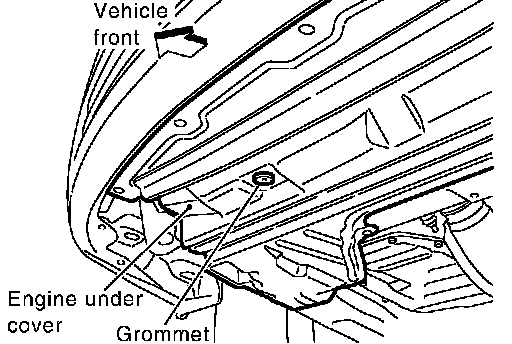
1. Remove grommet from engine undercover.
2. Open radiator drain plug at the bottom of radiator, and remove radiator cap.
When draining all of engine coolant in the system, open water drain plugs on engine cylinder block. Refer to "DISASSEMBLY".
3. Check drained engine coolant for contaminants such as rust, corrosion or discoloration. If contaminated, flush the engine cooling system. Refer to "FLUSHING COOLING SYSTEM".
4. Remove reservoir tank as necessary, drain engine coolant and clean reservoir tank before installing.
REFILLING ENGINE COOLANT
1. Install reservoir tank if removed, and radiator drain plug.
CAUTION: Be sure to clean drain plug and install with new O-ring.
Radiator drain plug: 1.17 Nm (0.12 kg-m, 10 inch lbs.)
If water drain plugs on cylinder block are removed, close and tighten them. Refer to "ASSEMBLY".
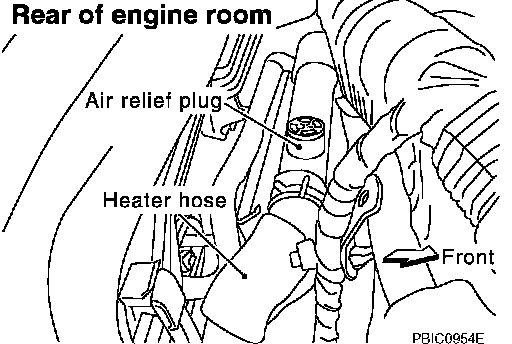
2. Remove air relief plug on heater hose.
3. Fill radiator and reservoir tank to specified level.
^ Use Genuine Nissan Long Life Antifreeze/Coolant or equivalent mixed with water (distilled or demineralized). Refer to "RECOMMENDED FLUIDS AND LUBRICANTS".
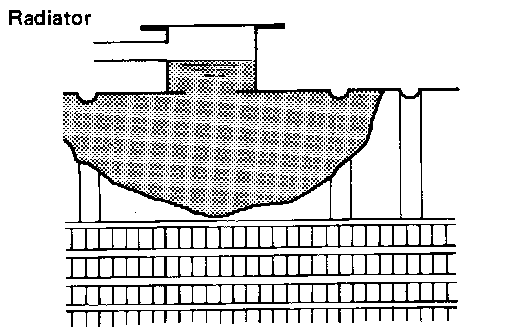
^ Pour engine coolant through engine coolant filler neck slowly of less than 2 L (2 - 1/8 US qts, 1 - 3/4 Imp qts) a minute to allow air in system to escape.
Engine coolant capacity (With reservoir tank at "MAX" level): Approximately 10.3 L (10 - 7/8 US qts, 9 - 1/8 Imp qts)
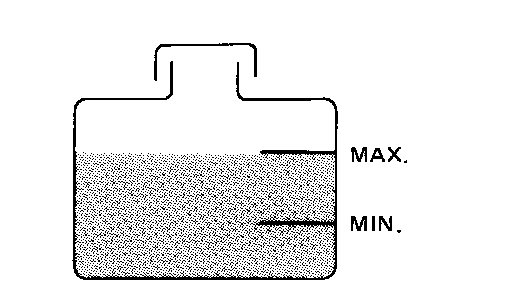
Reservoir tank engine coolant capacity (At "MAX" level): 0.8 L (7/8 US qts 3/4 Imp qts)
^ When engine coolant overflows air relief hole on heater hose, install air relief plug.
4. Install radiator cap.
5. Warm up until opening thermostat and water control valve. Standard for warming-up time is approximately 10 minutes at 3,000 rpm.
^ Make sure thermostat opening condition by touching radiator hose (lower) to see a flow of warm water.
CAUTION: Watch water temperature gauge so as not to overheat engine.
6. Stop engine and cool down to less than approximately 50°C (122°F).
^ Cool down using a fan to reduce the time.
^ If necessary, refill radiator up to filler neck with engine coolant.
7. Refill reservoir tank to "MAX" level line with engine coolant.
8. Repeat steps 3 through 6 two or more times with radiator cap installed until the engine coolant level no longer drops.
9. Check cooling system for leaks with engine running.
10. Warm up engine, and check for sound of engine coolant flow while running engine from idle up to 3,000 rpm with heater temperature controller set at several position between COOL and WARM.
^ Sound may be noticeable at heater unit.
11. Repeat step 10 three times.
12. If sound is heard, bleed air from cooling system by repeating steps 3 through 6 until engine coolant level no longer drops.
FLUSHING COOLING SYSTEM
1. Install reservoir tank if removed, and radiator drain plug.
Radiator drain plug: 1.17 Nm (0.12 kg-m, 10 inch lbs.)
If water drain plugs on cylinder block are removed, close and tighten them. Refer to "ASSEMBLY".

2. Remove air relief plug on heater hose.
3. Fill radiator with engine coolant until engine coolant spills from the air relief hole, then close air relief plug. Fill radiator and reservoir tank with engine coolant and reinstall radiator cap.
4. Run engine and warm it up to normal operating temperature.
5. Rev engine two or three times under no-load.
6. Stop engine and wait until it cools down.
7. Drain engine coolant from the system. Refer to "DRAINING ENGINE COOLANT".
8. Repeat steps 1 through 7 until clear water begins to drain from radiator.