Starter Solenoid: Testing and Inspection
Magnetic switch pull-in test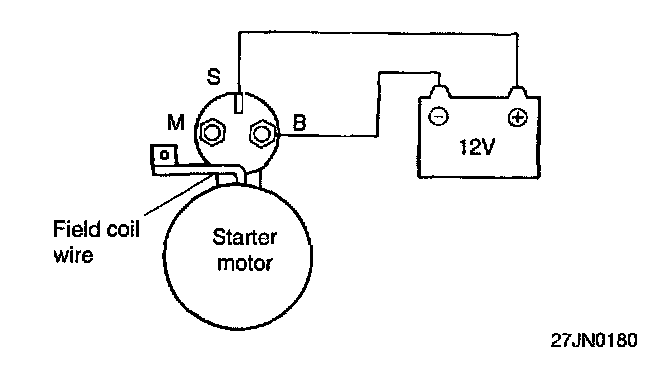
1. Disconnect the field coil wire from the terminal M of the magnetic switch.
2. Connect a 12 V battery between the terminal S and B.
CAUTION: The test must be performed as quickly as possible (in less than 10 seconds) to prevent the coil from being burned.
3. Moving out of the pinion implies that the pull-in coil is normal. Replace the magnetic switch if the coil does not move out.
Magnetic switch hold-in test
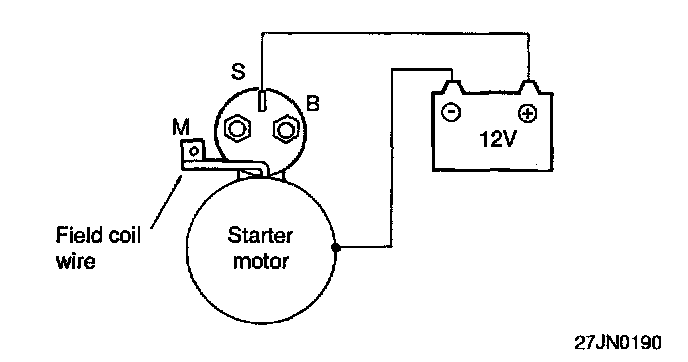
1. Disconnect the connector from the terminal M.
2. Connect a 12 V battery between the terminal S and the body.
CAUTION: The test must be performed as quickly as possible (in less than 10 seconds) to prevent the coil from burning.
3. If the pinion moves outside, everything is in order. But if the pinion moves inside, replace the magnetic switch.
Performance test (No load)
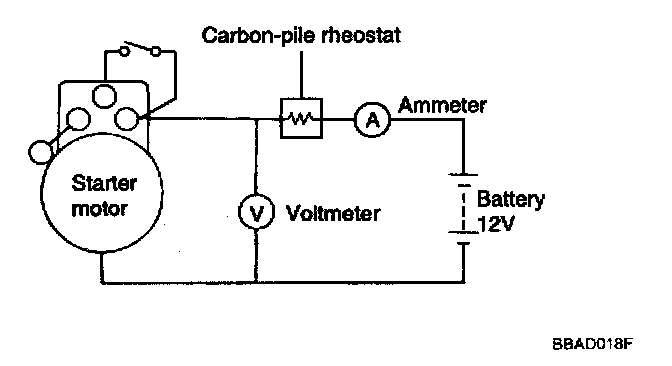
1. Place the starter motor in a vise and connect a 12 V battery after charging to the starter motor.
2. Connect an ammeter (100 A) and carbon pile rheostat as shown in the illustration.
3. Connect a voltmeter (15 V) across the starter motor.
4. Turn the carbon pile to OFF position.
5. Connect a battery cable from the battery negative post to the body of starter motor.
6. Regulate the voltmeter to obtain 11 V reading of battery voltage.
7. Confirm that the max. Amperage is within the specification and that the starter motor turns smoothly and freely.
Speed : Min. 2,800 rpm
Current: Max. 90 A
Return test of solenoid
1. Disconnect the field coil wire from the terminal M.
2. Connect a 12 V battery between terminal B and the body.
NOTE: The test must be performed as quickly as possible (in less than 10 seconds) to prevent The coil from burning.
3. Try to pull the pinion outward and release. If the pinion returns quickly to its original position, everything is in order. If not, replace the solenoid.