Customer Safety Information
The various major assemblies in the air bag system have been designed to be tamper-resistant and are not intended to be disassembled for service. Component assemblies may be removed and replaced as required. Information on proper handling, storage, and disposal of the air bag inflator assemblies is provided.
Repair of Air Bag Equipped Vehicles Involved in Accidents
While repairing an air bag equipped vehicle that has been involved in an accident, check sensors and wiring.
Vehicle sensor orientation is critical for proper system operation. If a vehicle equipped with an air bag system is involved in a crash where the fenders or grille area have been damaged, inspect the sensor mounting brackets for damage. If damaged, the sensor should be replaced whether or not the air bag is deployed. In addition, ensure that body structure in the area of the sensor mounting is restored to its original condition.
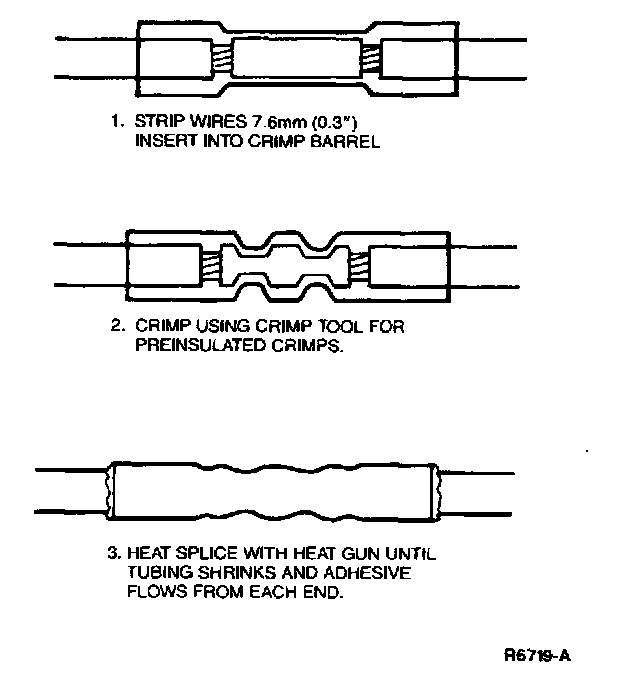
Inspect the sensor wiring and the wiring harness for any damage that may have occurred due to the accident. Repair or replace any damaged wiring, terminals, insulation, or connectors, as required. If splices are required in adjacent wiring, the splices should be staggered 50 mm (2 inches) apart. Repair as follows:
A waterproof butt splice connector should be used on all wiring repairs in the engine compartment. A heat shrink nylon splice prevents water, salt, condensation and heat from affecting the wiring repair.
The inner wall of the splice connector is lined with an adhesive that melts when heated with a heat gun and flows under pressure from the tubing, sealing the splice. The connectors can be crimped with a standard insulated connector crimping tool. The splices are color coded for gauge identification, and are transparent to allow inspection of the finished splice.