Vehicle Certification (VC) Label
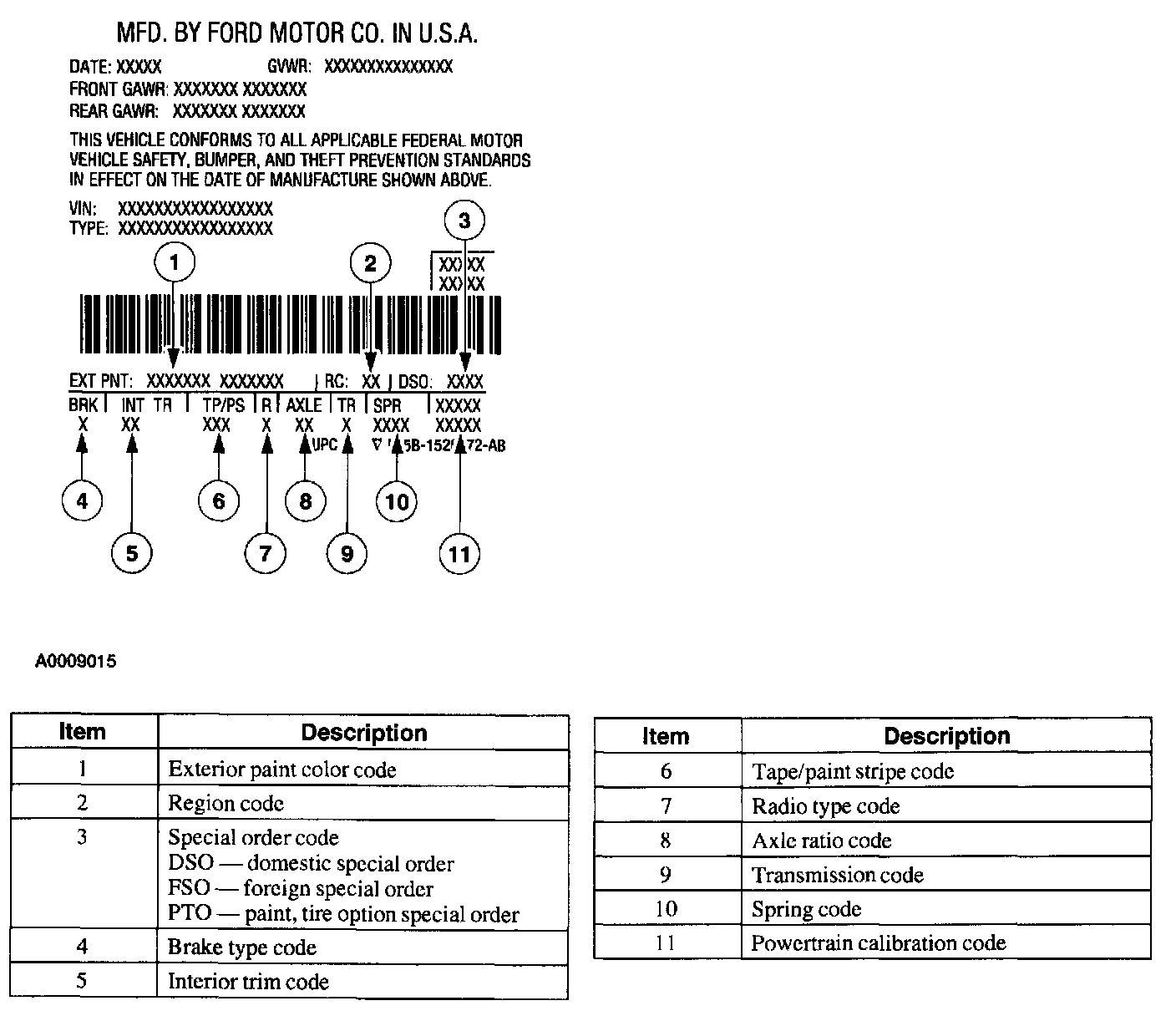
VC Label-Incomplete Vehicle (Typical):
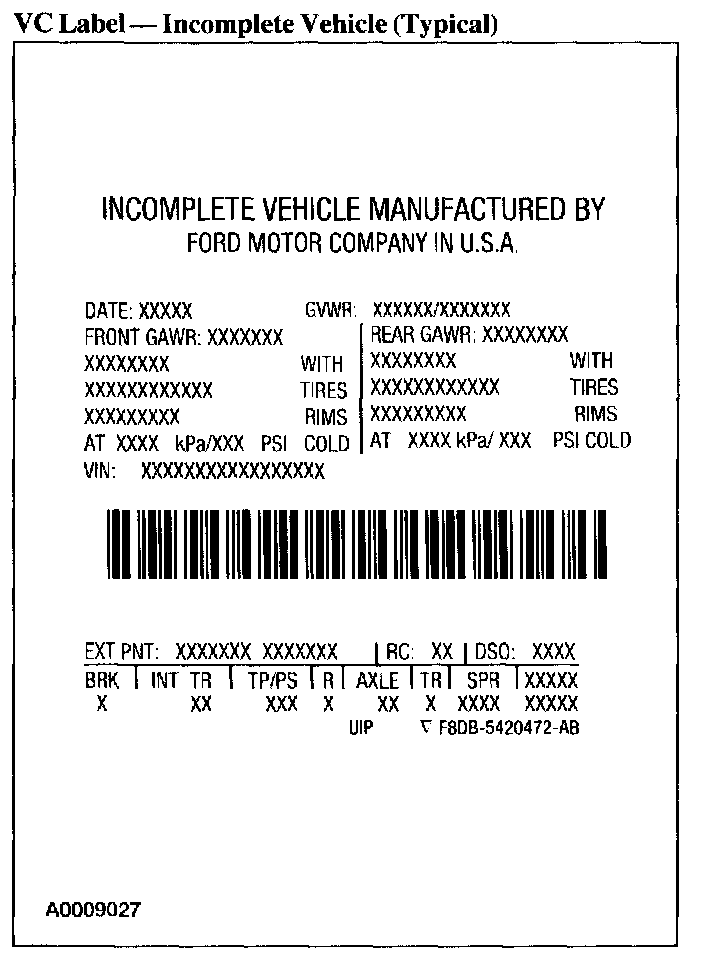
The upper portion of the Vehicle Certification (VC) label contains the manufacturer name, the month and year of manufacture, the certification statement and the VIN. It also includes Gross Vehicle Weight Ratings (GVWR). The VC label is located on the front left-hand door jamb.
VEHICLE CERTIFICATION (VC) LABEL REFERENCE
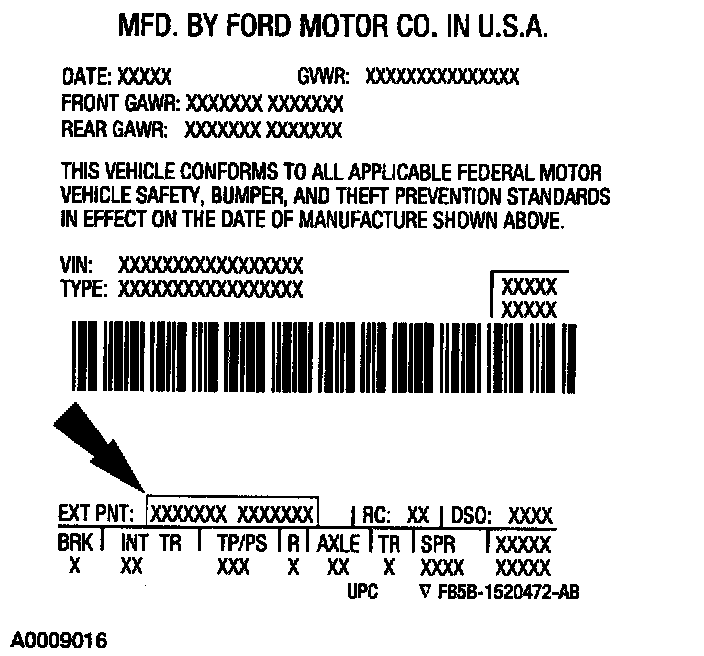
The first set of paint code letters listed indicate the vehicle primary body color. The second set of letters listed (if applicable) indicate a two-tone or accent body color. All colors are base coat/clear coat.
Primary Body Color Codes
^ BQ - Light Parchment Gold
^ HC - Ivory Parchment (tri-coat)
^ GT - Autumn Red
^ L2 - True Blue Metallic
^ L3 - Medium Pacific Blue Metallic
^ P5 - Aspen Green Metallic
^ TS - Silver Frost
^ TV - Midnight Gray
^ UA - Ebony
^ WF - White Pearl (tri-coat)
^ WT - Performance White
Two-Tone Color Codes
^ RC - Medium Platinum, Signature Series
^ BQ - Light Parchment Gold, Signature Series
^ TS - Silver Frost, Signature Series
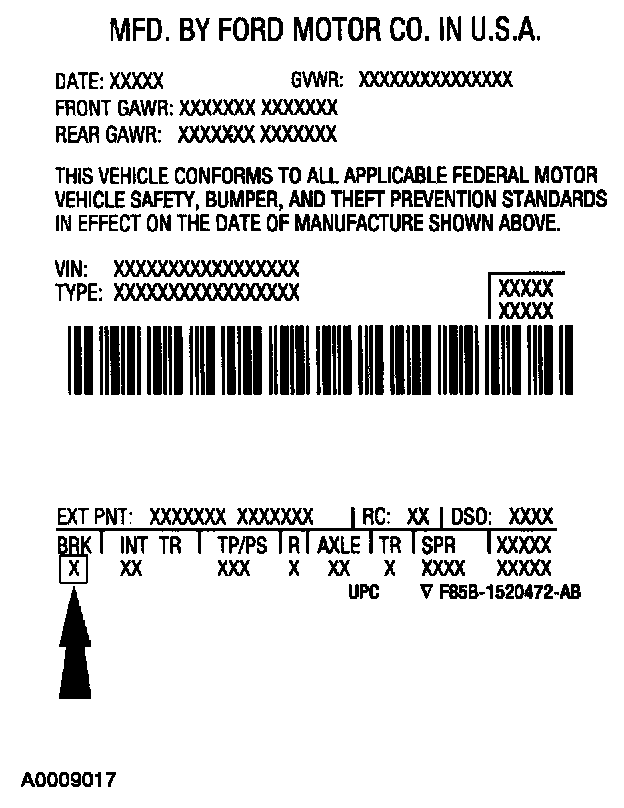
The brake type codes are:
^ 3 - Four-wheel disc brakes with Anti-Lock Brake System (ABS) with Traction Control
^ Blank - ABS brakes without Traction Control
Interior Trim Codes:
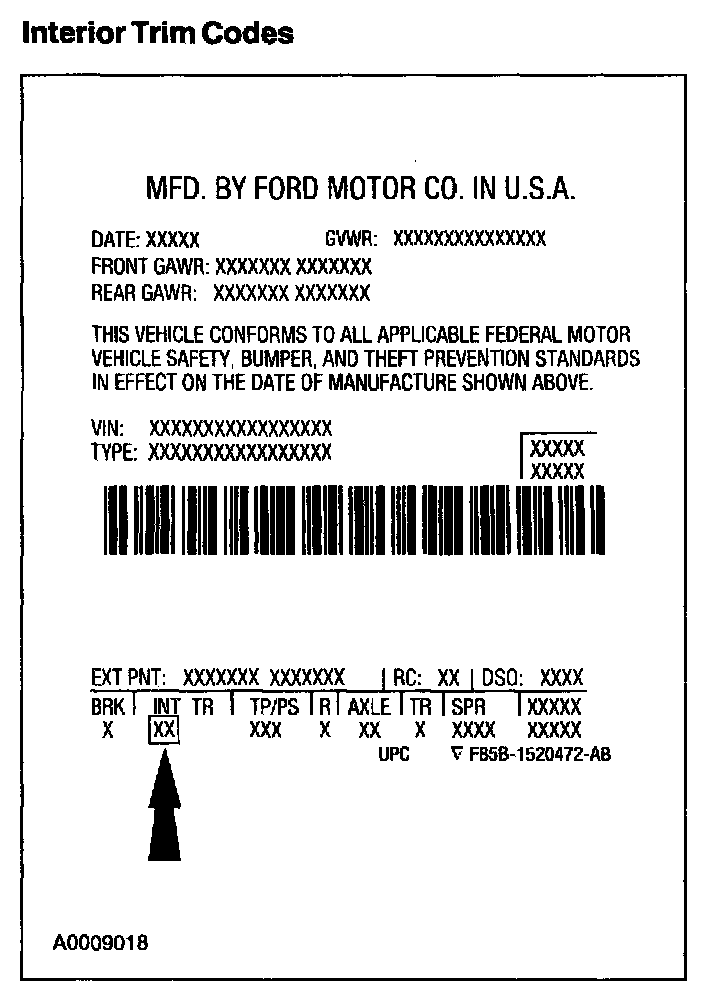
The interior trim codes are listed below. The first digit indicates the interior fabric. The second digit indicates the interior color.
^ S - G-grain leather (standard on Executive and Signature series)
^ Q - Nudo leather (standard on Cartier series)
^ X - G-grain leather (standard and only available on handling package)
The interior trim colors are:
^ R - Dark Denim
^ L - Oxford White/Light Graphite
^ H - Medium Parchment
^ G - Light Parchment
^ 2 - Light Graphite
^ W - Midnight Black
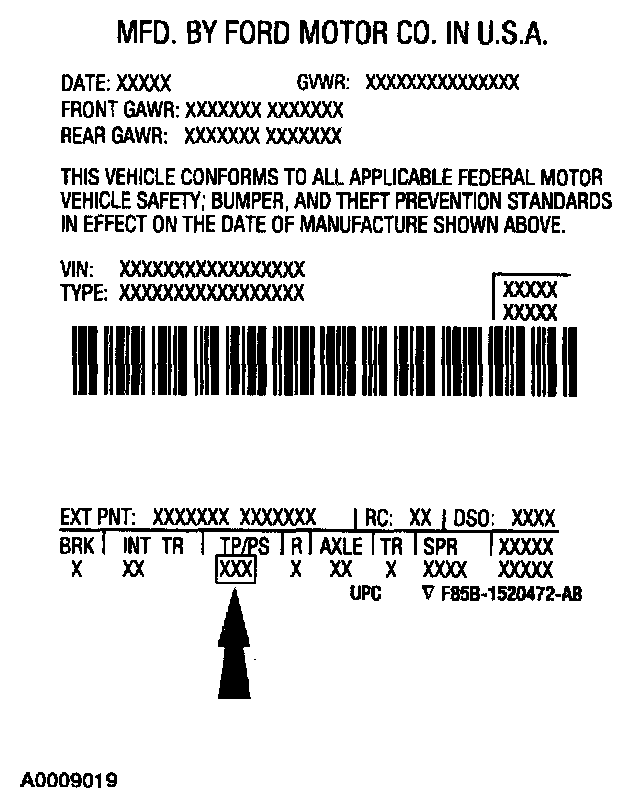
Tape and paint stripe codes do not apply.
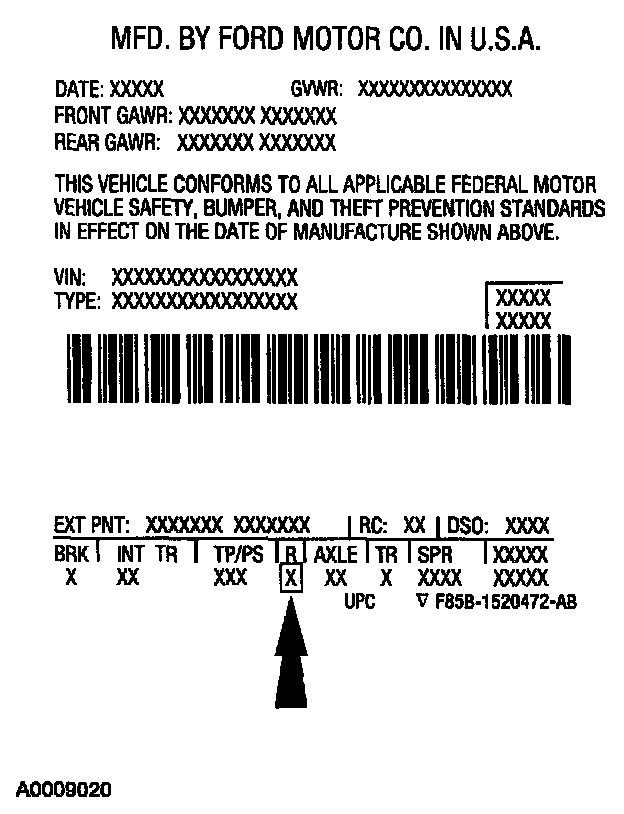
The radio type codes are:
^ 6 - P100i Premium AM/FM electronic stereo with cassette
^ H - M100 AM/FM stereo with cassette
^ L - A100i Premium AM/FM electronic stereo with cassette, electronically tuned
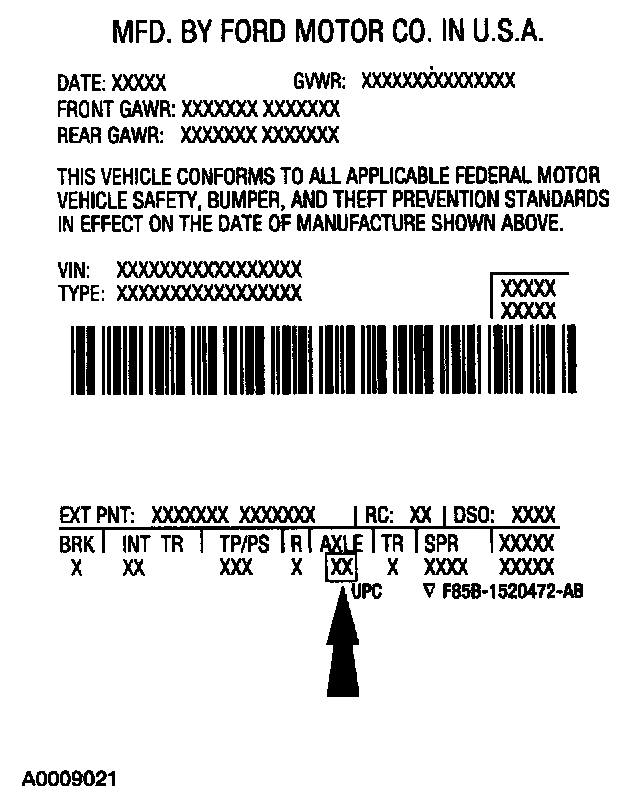
The axle ratios are:
^ JY - 3.08 conventional
^ 55 - 3.55 conventional
^ 55 - 3.55 locker (limousine and hearse only)
^ MY - 3.08 conventional
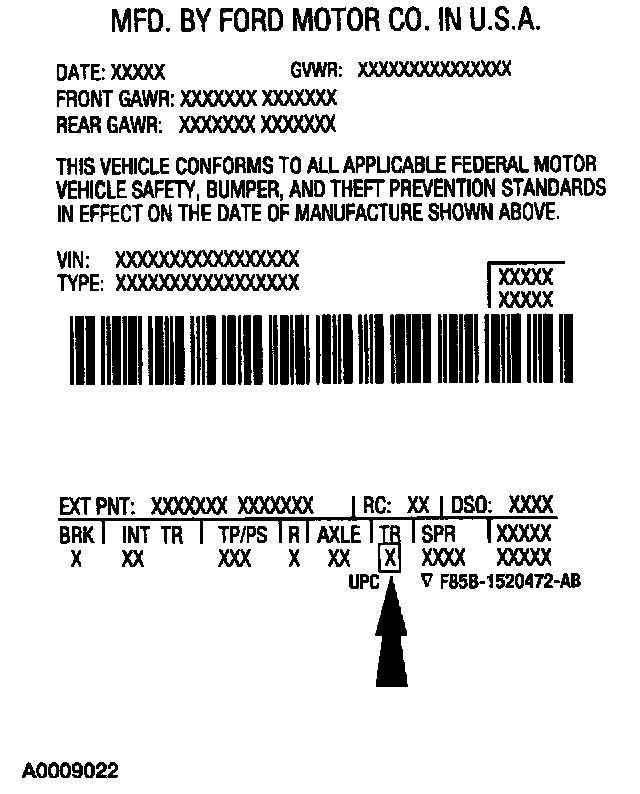
The transmission code is:
^ U - Four-speed automatic overdrive (4R70W)
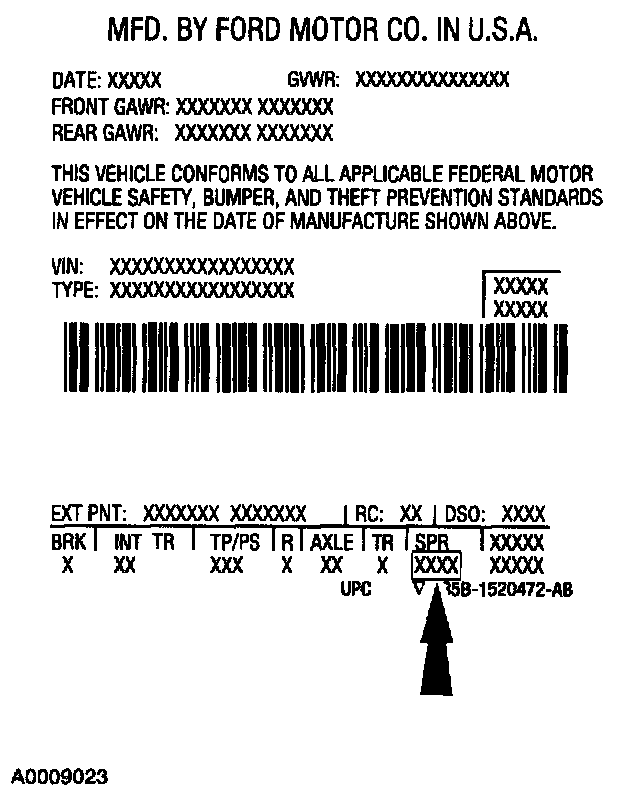
The spring codes are:
NOTE: Town Car uses a rear air suspension system. Spring identification is not required.
^ F - F4AC-5310-F - Catchword FPK
^ C - F4AC-5310-C - Catchword CKV
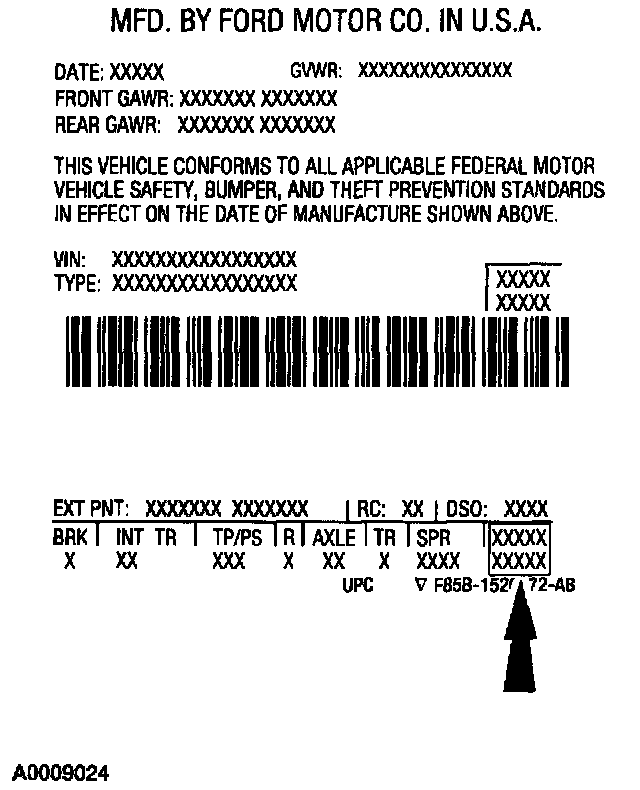
Powertrain Calibration Information
NOTE: Powertrain calibration information is limited to a maximum of five characters per line on the Vehicle Certification Label. Because of this, calibration identification consisting of more than five characters will wrap to the second line on the VC label.
Powertrain calibration information is printed in the lower right corner of the Vehicle Certification Label. Only the base calibration information is printed. Revision levels will not appear, however, they can be found in On Line Automotive Service Information System (OASIS). For the current model year, Ford Motor Company is using three different protocols which describe powertrain base calibration. These protocols are designed to provide worldwide standardization for vehicle calibration. If the electronic calibration strategy has been used since 1998 and carried into the current model year, Protocol 1 will be used. Refer to Protocol 1. If the electronic calibration strategy has been used since 1999 and is carried into the current model year, Protocol 2 will be used. Refer to Protocol 2. For electronic calibration strategies introduced since the 2000 model year, use Protocol 3. Refer to Protocol 3.
Protocol 1:
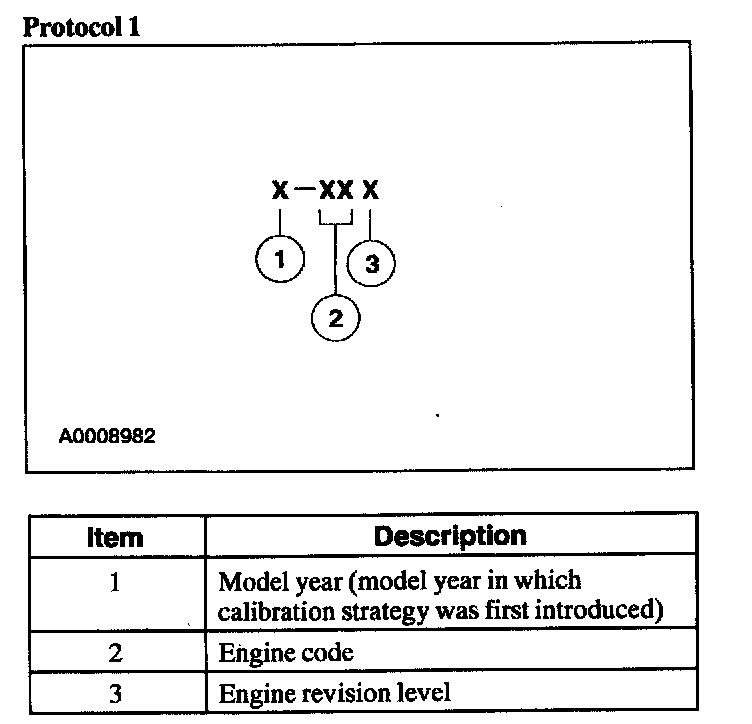
Protocol 1
Protocol 2:
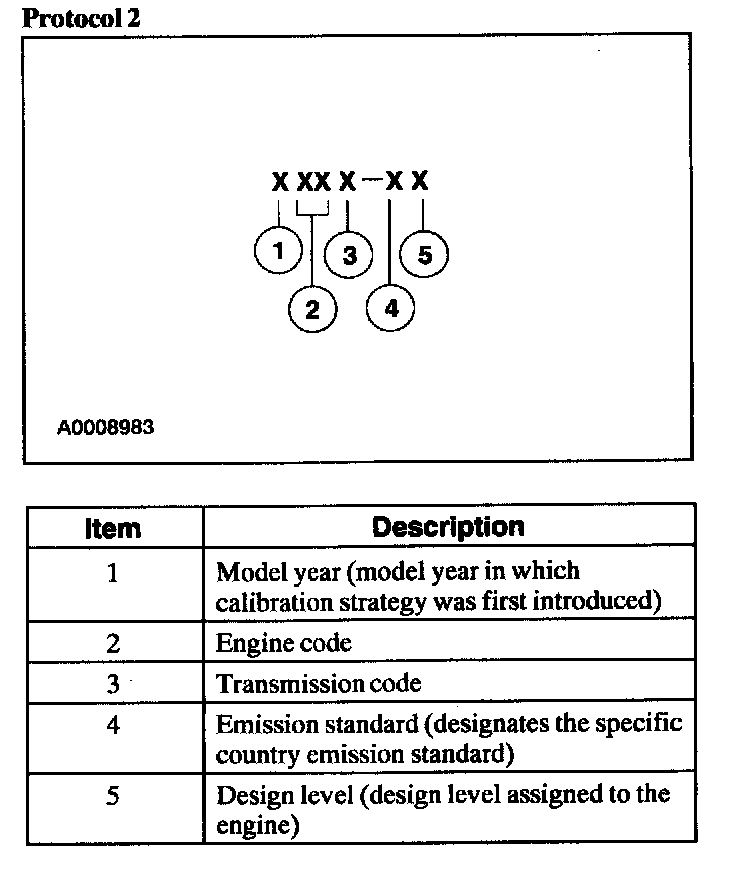
Protocol 2
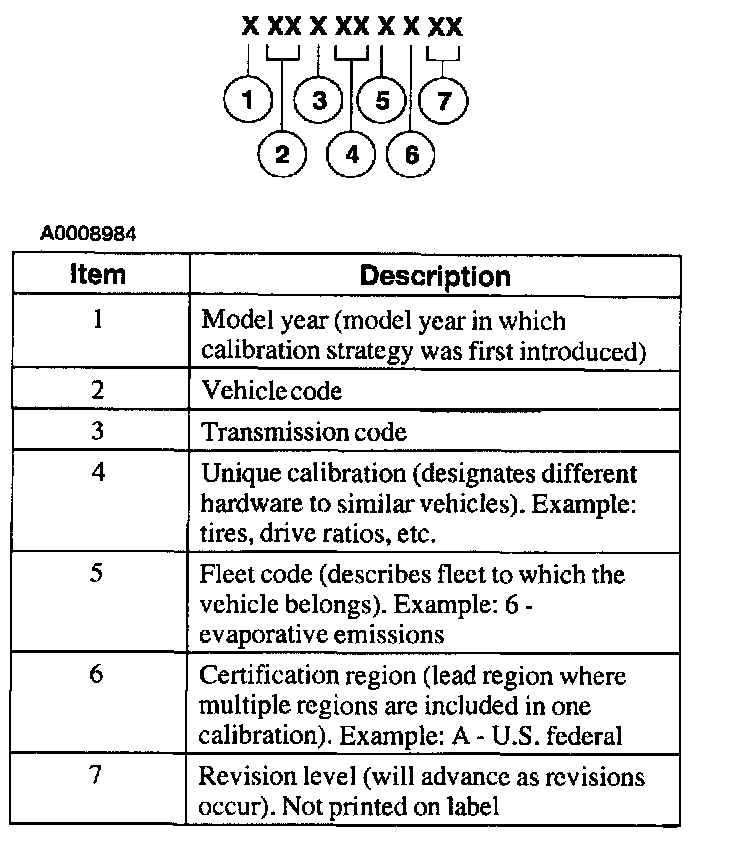
Protocol 3
The following offers a more detailed explanation of the coding strategy used for Protocol 3.
Model Year
^ 0 - 2000
^ 1 - 2001
^ 2 - 2002
Vehicle Line
^ VC - Lincoln Town Car
Transmission
^ 1 - Automatic transmission
Unique Calibration
The Emission/CAFE/CO2 Compliance Department is responsible for assigning these calibration numbers. Unique calibration identifications are assigned to cover similar vehicles to differentiate between tires, drive configurations, final drive ratios and other certification-significant factors.
These two characters are chosen by the analyst to provide easily identifiable information unique to each calibration. For example, using the number 2 to denote a two-valve engine versus the number 4 to denote a four-valve engine.
Fleet Code
^ 0 - Certification (U.S. 4K, final sale in an export market)
^ 1 - HDGE/Dyno
^ 2 - Fast AMA U.S.
^ 3 - ADP U.S.
^ 4 - Not assigned
^ 5 - Not assigned
^ 6 - Evaporative emissions
^ 7 - MACAA
^ 8 - On-board diagnostics
^ 9 - Not assigned
Certification Region
^ 5 - U.S. fifty states
^ A - U.S. federal, including altitude, may include Canada, may include Mexico
^ B - U.S. California standard, includes U.S. green states
^ C - Canada
^ D - China
^ E - European community (Austria, Belgium, Denmark, Finland, France, Germany, Greece, Ireland, Italy, Luxembourg, Netherlands, Portugal, Spain, Sweden and United Kingdom
^ F - Extended european community (E plus Croatia, Czech Republic, Estonia, Hungary, Norway, Poland, Romania, Russian Federation, Slovakia, Slovenia, Switzerland and Yugoslavia)
^ G - Gulf Cooperative Council (Bahrain, Kuwait, Oman, Qatar, Saudi Arabia and UAF)
^ H - Hong Kong
^ J - Japan
^ K - Korea
^ L - Malaysia
^ M - Mexico
^ N - New Zealand
^ P - Australia
^ Q - South America (Brazil)
^ S - Singapore
^ T - Taiwan
^ U - South America (unleaded fuel regions)
^ V - Vietnam
^ X - Rest of world (ROW)
^ Y - Military
^ Z - Israel
Revision Level (not printed on label)
^ 91-99 - Hardware and certification levels
^ 01-04 - Preliminary levels
^ 00 - Job 1 production (initial certification)
^ 05-09 - Pre-job 1 revisions to calibrations
^ 10-89 - Post-job 1 revisions to calibrations
^ 0B - Durability test level
^ BD - On-board diagnostics (OBD) intermediate level (pre-05)