Wheel Bearings Diagnosis
A road test can usually indicate excessive wheel bearing noise. Although it is difficult to verbally describe sound, wheel bearing generally emit a kind of howling sound when they go bad. This sound is only present when the vehicle is moving, it is constant and unwavering, and it increases in loudness and pitch with vehicle speed. If wheel bearing noise cannot be positively diagnosed, or if the front or rear origin of the noise cannot be determined, perform the following wheel bearing test:1. Raise and support the vehicle.
2. Spin the wheels by hand. Check for out-of-round tires, out-of-balance tires, bent rims or loose wheel bearings.
CAUTION: On front-wheel drive vehicles, drive wheel spin should be limited to 56 km/h (35 mph) as indicated on the speedometer. This limit is necessary because the speedometer on some front-wheel drive vehicles only indicates half of the actual wheel speed when one wheel is spinning and the other wheel is stopped Unless care is taken to limit drive wheel spin, the spinning wheel can reach excessive speed. This could result in possible tire disintegration or differential failure, which could cause serious personal injury or extensive vehicle damage.
3. Spin the rear wheels using a commercial wheel spinner. Spin the front wheels using the engine.
4. If noise can be heard from the passenger compartment, replace the noisy wheel bearing cartridge. Refer to WHEEL BEARING in FRONT SUSPENSION or WHEEL BEARING in REAR SUSPENSION.
5. Lower the vehicle.
Tools Required:
- J 8001 Indicator Set
- J 26900-13 Dial Indicator Post
Perform the following test to check for looseness in the bearing cartridge assembly.
1. Raise the vehicle. Support the vehicle.
2. Remove the front or rear wheel and tire assemblies. Refer to WHEEL REMOVAL.
3. Perform the following procedure for disc brakes:
3.1. Reinstall two wheel lug nuts to hold the rotor tight.
3.2. Compress the caliper piston to free the caliper assembly.
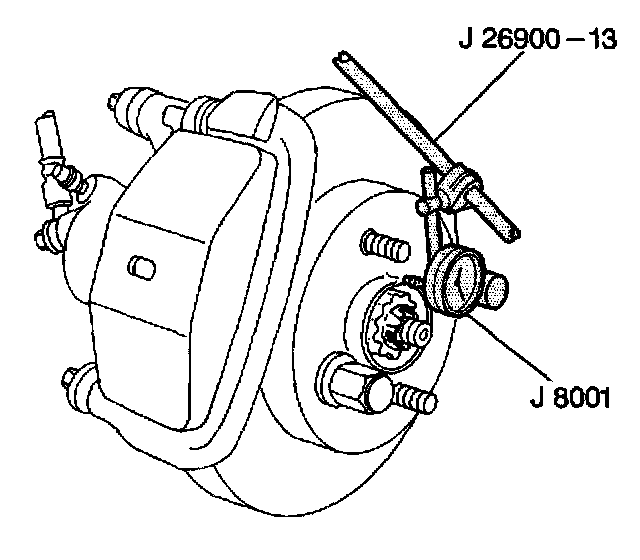
3.3. Mount J 8001 and J 26900-13.
3.4. Push and pull the brake rotor by hand. If the rotor movement exceeds 0.4 mm (0.016 in), replace the wheel bearing. Refer to WHEEL BEARING AND WHEEL HUB REPLACEMENT (WHEEL HUB REPLACEMENT).
4. Perform the following procedure for drum brakes:
4.1. Remove the brake drum.
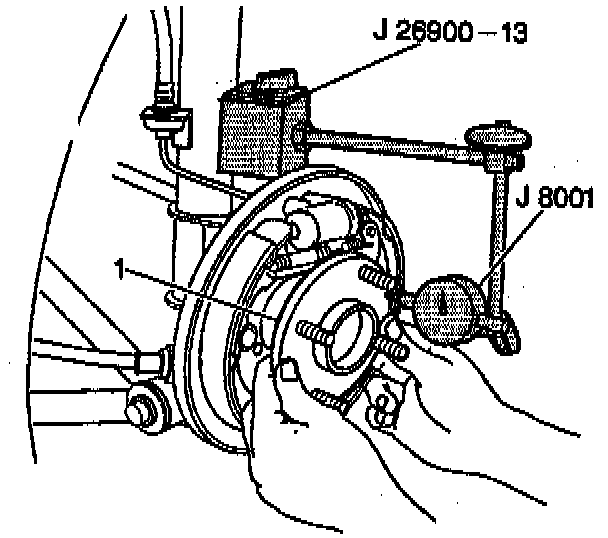
4.2. Mount J 8001 and J 26900-13.
4.3. Push and pull the hub unit by hand. if the hub movement exceeds 0.3 mm (0.012 in), replace the wheel bearing. Refer to REAR WHEEL HUB AND BEARING REPLACEMENT.
5. Install the tire and wheel assemblies. Refer to WHEEL INSTALLATION.
6. Lower the vehicle.