Rear
WM 463819 Removing and installing rear disc brake pads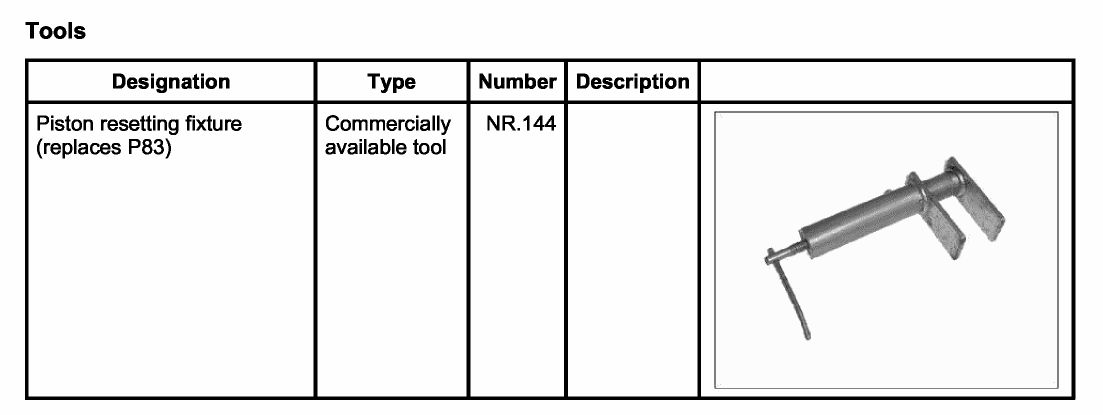
Preliminary work
Raise the vehicle.
Remove wheel.
Removing
Removing rear disc brake pads
The core of the warning contact line must not be left exposed! It does not matter if the insulation is worn!
If necessary, remove a little brake fluid from the expansion tank by suction to prevent overflow when the disc brake pad is pushed back!
1. Remove lock (securing clip) -top arrow- from retaining pin and remove retaining pin -direction arrow- inwards.
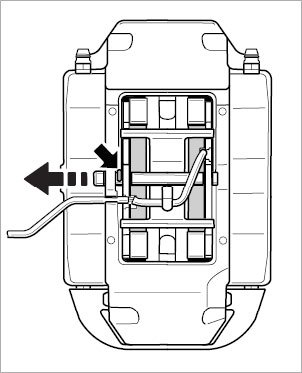
2. Remove warning contact line from brake caliper and expanding spring. Remove warning contacts from the brake disc pads.
3. Remove expanding spring.
4. Piston resetting fixture (replaces P83) NR.144, must be fitted on the brake caliper between the disc brake pads in order to push the pads back evenly -direction arrows-.
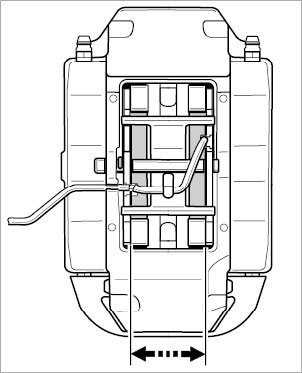
5. Remove disc brake pads.
Installing
Installing rear disc brake pads
Warning:
Danger of accidents if old parts are fitted on brake caliper.
Fit new expanding spring, new retaining pin and new securing clip on the brake caliper.
Warning:
Danger of accidents if brake pads of the wrong quality are installed.
Use only the type-specific brake pads listed in the Porsche Spare Parts Catalogue.
Information:
The back of the pad backing plates must not be greased.
Check disc brakes for wear.
Disc brakes must be clean and free of grease.
The core of the warning contact wire must not be left exposed! It does not matter if the insulation is worn.
If necessary, remove a little brake fluid from the expansion tank by suction to prevent overflow when the disc brake pad is pushed back.
Use new repair kit.
Observe tightening torques.
1. If necessary, push brake piston back into its original position using the piston resetting fixture (replaces P83) NR.144.
2. Fit disc brake pads.
3. Fit expanding spring, retaining pin -direction arrow- and lock (securing clip) -top arrow- for retaining pin.
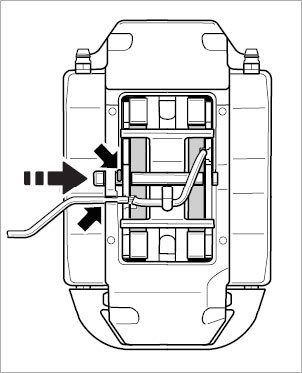
4. Fit warning contact line on brake caliper -bottom arrow- and warning contacts on disc brake pads.
5. Press the brake pedal several times while the car is stationary to position the pads on the brake disc.
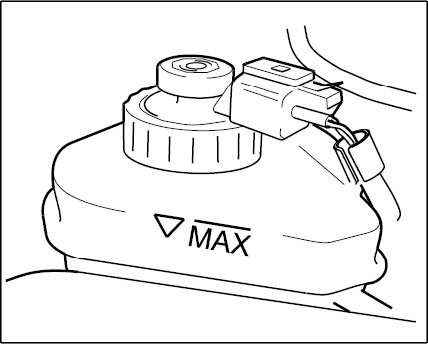
6. Check brake fluid level and correct it if necessary. The brake fluid level must be between the -MIN/MAX marking-.
Subsequent work
1. Mount wheel.
Information
Bedding in the brake pads
New brake pads require a bedding-in period of approx. 200 km! Only then do they achieve their best friction and wear coefficient! During this period, the brakes should only be subjected to full stress at high speed in emergencies!