Tires/Wheels - Balancing & Runout Information
83subaru1NUMBER 05-13-83
DATE 03-02-83
APPLICABILITY ALL VEHICLES
SUBJECT: TIRE AND WHEEL BALANCING
This bulletin has been prepared to assist in the diagnosis and repair of tire and wheel vibrations. It is for informational purposes only. Please read the entire bulletin prior to diagnosing a complaint vehicle..
ROAD TEST
Test drive the vehicle to verify that a tire and/or wheel vibration exists. Note the vehicle speed at which the vibration occurs.
TIRE AND WHEEL IMBALANCE
Tire and wheel imbalance causes a constant, low frequency vibration at speeds over 30 miles per hour.
To properly balance the tire and wheel, it is recommended to use an off-the-car or on-the-car dynamic spin balancer. Static or bubble balancers should not be used. Stud mounting adapters, rather than center hole mounting, are recommended on balance equipment to achieve the most accurate balance.
Before proceeding with the balancing operation, check the following:
Tire air pressure Lug nut torque Bearing preload Tire tread or sidewall for damage Debris in tire tread Wheel damage Any non-factory type equipment
Follow the equipment manufacturer instructions when balancing tires and wheels. It is also important that the equipment is in good working condition. Wheel balancing equipment should be periodically checked and recalibrated if necessary.
WHEEL RUNOUT
Though not as common as imbalance, excessive wheel runout can be a cause of vibration problems.
FIGURE 1:
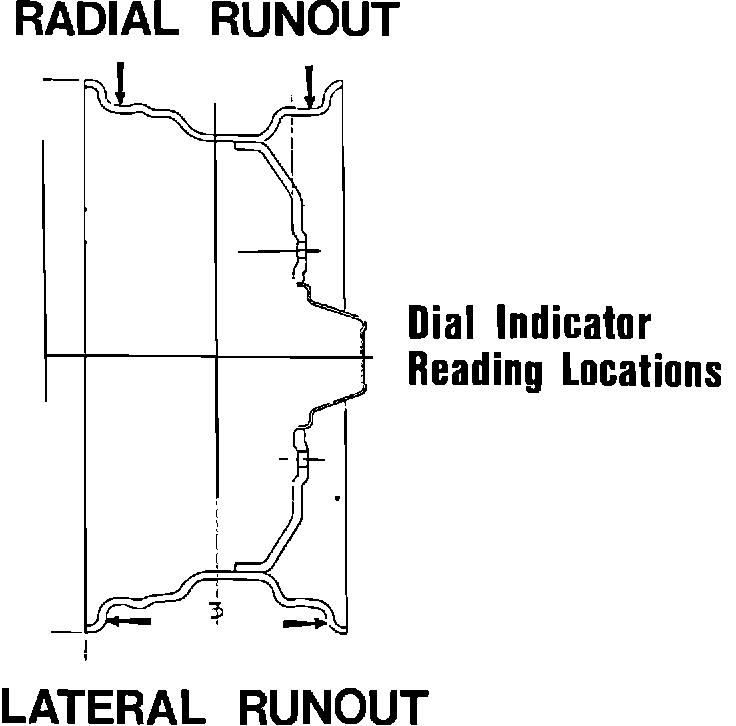
Radial runout or "out of round" and lateral or "side to side" runout should not exceed .047 inches. If a wheel is suspected to have excessive radial or lateral runout, it can be checked by measuring the runout at the points shown in Figure 1.
If any of the runout figures obtained exceed .047 inch, check the following as a possible cause:
A. All steel wheels have a weld where the rim area was welded into a hoop after a curling operation. This weld will usually produce a localized high dial indicator reading that does not affect wheel performance and is not cause for wheel replacement.
B. Scratches such as those caused by tire mount/dismount equipment will cause the dial indicator needle to jump. These scratches are not cause for wheel replacement.
C. Any time a runout reading exceeds .047 inch, check the spot where the highest reading was obtained to see if it was caused by dirt, tire residue, scratches, etc. If this was the cause., clean or dress the wheel and repeat the procedure.
If radial or lateral runout in excess of .047 inch is not caused by A, B, or C above, replace the wheel.