Compression Check: Testing and Inspection
Compression, Checking
Special tools, testers and auxiliary items required
• Puller (T10095A)
• Torque wrench (5 to 50 Nm) (V.A.G 1331)
• Compression tester (V.A.G 1763)
• Spark plug removal tool (3122 B)
• Assembly tool (T10118)
Test Conditions
• Engine oil temperature must be at least 30° C.
• Battery voltage must be at least 11.5 V.
• All electrical consumers such as, for example, lights and rear window defroster must be switched off.
• If the vehicle is equipped with an air conditioning system, this must be switched off.
• For vehicles with automatic transmission, selector lever must be in position "P" or "N".
• Fuses - 13 - and - 14 - - arrows - must be removed from their sockets.
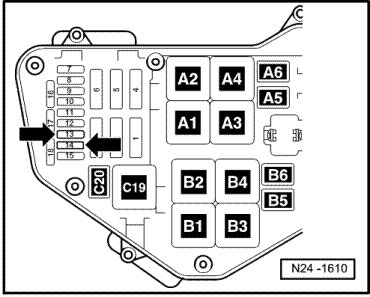
Test Sequence
- Remove engine cover.
- Remove ignition coils with power output stage --> [ Ignition Coil with Power Output Stage ] Service and Repair.
- Remove spark plugs using spark plug removal tool (3122 B).
- Check compression pressure using the compression tester (V.A.G 1763).
• Using the compression tester --> Operating instructions.
- Have a second technician fully depress accelerator pedal and crank engine.
- Operate starter until tester shows no further pressure increase.
Compression Pressure
New: 10 to 13 bar pressure
Wear limit: 7.5 bar pressure
Permissible difference between all cylinders: 3 bar
- Install the spark plugs using the spark plug removal tool (3122B) and tighten to 20 Nm.
After completing installation:
- Connect vehicle diagnosis and service system (VAS 5052).
- Perform vehicle system test "Guided Fault Finding".
- End vehicle system test, this will automatically erase DTC entries which occurred during the assembly.
- Perform test drive.
- Generate readiness code in conjunction with road test.
Observe safety precautions that apply to road tests.
- Then perform vehicle system test again and repair any occurring malfunctions if necessary.