Fuel Delivery, Checking
Fuel Delivery, Checking
Special tools, testers and auxiliary items required
• Hand held remote control (jumper).
• Multimeter.
• Electrical connector test lead set.
• Fuel pressure test set (high pressure).
• Measuring container, fuel-resistant.
Test conditions
• Battery voltage 12.5 V
• Fuel filter OK
• Fuel tank at least 1/4 filled.
• Fuel pressure regulator OK.
• Ignition switched off.
Test procedure
- Perform a preliminary check to verify the customers complaint. Refer to => [ Preliminary Check ] Preliminary Check.
Start diagnosis
- Remove the fuel filler cap from fuel filler tube.
- Remove rear seat bench.
- Remove cover retainers - arrows - from the right sealing flange.
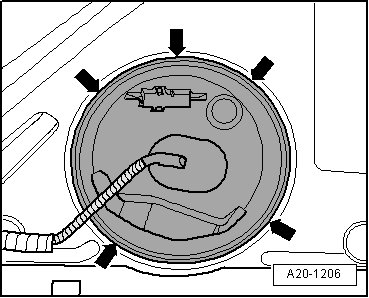
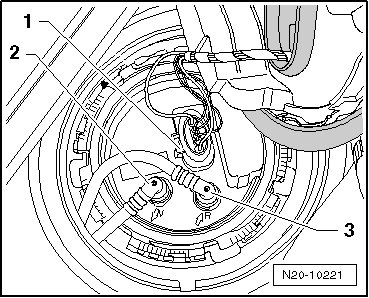
- Disconnect the electrical harness connector - arrow - from the fuel delivery unit.
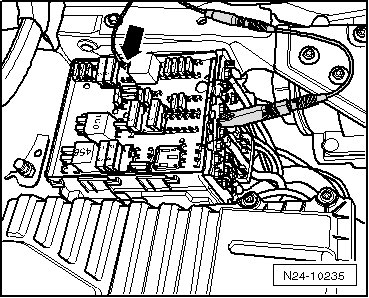
- Open cover of relay and fuse panel in the engine compartment E-box.
- Remove fuse SB-7 from fuse holder
- Connect hand held remote control (jumper) to the left terminal (in direction of travel) of fuse socket. - arrow -.
- Using insulating tape, tape over second contact of hand held remote control (jumper) to prevent a short circuit.
- Connect alligator clip to vehicle battery B+.
Fuel system is under pressure! Before opening the system, place rags around the connection area. Then release the pressure by carefully loosening the connection.
- Disconnect return line - 1 - from fuel pressure regulator.
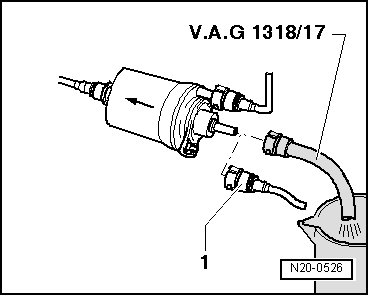
• Press in securing ring to disengage the fuel line.
- Connect adapter hose to fuel pressure regulator and hold end of adapter in a measuring container.
- Run hand held remote control (jumper) approximately 5 seconds to fill the fuel filter.
- Empty measuring container.
- Delivery rate of Fuel Pump is dependent on voltage. Therefore connect multimeter to battery.
- Operate remote control for 30 seconds and measure battery voltage.
- Compare the quantity of fuel delivered with specification.
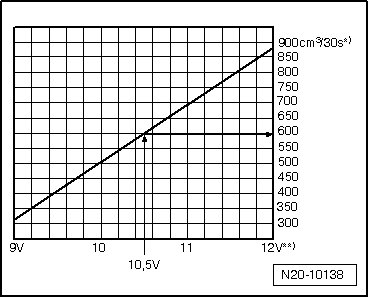
* Minimum delivery rate cm3/30 s
** Voltage at fuel pump with engine off and pump running (approx. 2 Volts less than battery voltage).
Example:
During test, a voltage of 12.5 volts is measured at the battery. Since the voltage at the pump is approx. 2 Volts less than battery voltage, there is a minimum delivery rate of approx. 580 cm3/30 s.
If the minimum delivery rate is not attained:
- Check the supply line to filter for possible restrictions (kinks) or clogging.
If fuel line is OK.
- Check fuel delivery rate in front of fuel filter.
- Disconnect the supply line from fuel filter input.
• Press in securing ring to disengage the fuel line.
- Connect a Fuel pressure test set (high pressure) as shown.
- Connect an adapter hose to the Fuel pressure test set (high pressure) and hold it in a measuring container.
- Open shut off valve of Fuel pressure test set (high pressure). Lever will point in direction of flow.
- Operate hand held remote control (jumper). Slowly close shut off tap, until pressure gauge shows 4 bar. From this point on do not move position of shut off tap.
- Empty the measuring container.
- Operate hand held remote control (jumper) for 30 seconds. Compare delivery quantity with value determined from the first measurement.
If minimum delivery rate is now obtained:
- Replace fuel filter.
If minimum delivery rate is again not obtained:
- Remove fuel delivery unit and check filter strainer for dirt.
If the fuel filter and fuel strainer are OK:
- Replace fuel delivery unit.
Assembly is performed in reverse order of removal.
Final procedures
After repair work, the following work steps must be performed in the following sequence:
1. Check the DTC memory. Refer to => [ Diagnostic Mode 03 - Read DTC Memory ] Diagnostic Modes 01 - 09.
2. If necessary, erase the DTC memory. Refer to => [ Diagnostic Mode 04 - Erase DTC Memory ] Diagnostic Modes 01 - 09.
3. If the DTC memory was erased, generate readiness code. Refer to => [ Readiness Code ] Monitors, Trips, Drive Cycles and Readiness Codes.