Holding Pressure, Checking
Holding Pressure, Checking
Special tools, testers and auxiliary items required
• Pressure Tester (VAS 6550)
• Vehicle Diagnostic Tester
• The fuel pressure is OK and the pressure tester (VAS 6550) is still connected. Checking the fuel pressure, refer to => [ Fuel Pressure, Checking ] Fuel Pressure, Checking.
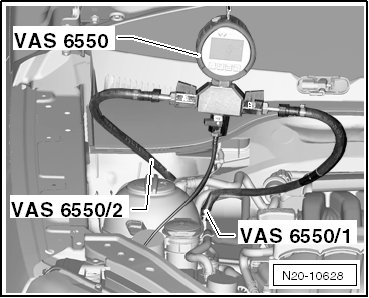
Test Sequence
- Activate the fuel pump with output diagnostic test mode to build fuel pressure.
- Read the fuel pressure on the pressure tester.
• The pressure may not fall more than 1 bar within 10 minutes.
If the pressure drops further:
- Activate the fuel pump with output diagnostic test mode to build fuel pressure.
- Close the shut off lever - B - on the pressure tester immediately after the pressure has been reached. The pressure tester now shows the pressure on the fuel tank side.
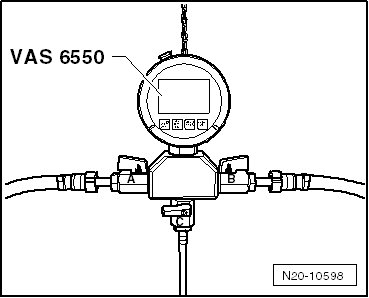
If the pressure no longer drops now:
The fuel tank side is sealed. Look for leaks on the engine side. Repeat the residual pressure check. Close the shut off lever - A - this time to determine if there actually is a leak on the engine side.
- Check all fuel hoses and fuel pipes on the engine if there is a lead on the engine side.
• A faulty fuel injector or a faulty high pressure pump on an FSI engine can cause leaks.
If the pressure drops again:
Check for the leak on the fuel tank side. Proceed as follows:
- Check the fuel line to the fuel tank for leaks.
If no malfunctions are found with the fuel line.
- Open the fuel delivery unit flange - 1 -.
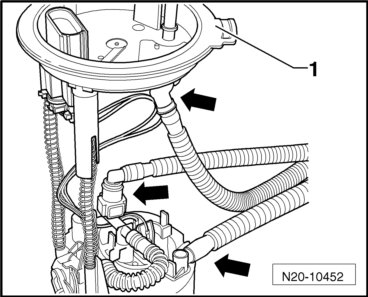
- Make sure all hose connections - arrows - are connected.
If no malfunction can be found:
The pressure relief valve in the fuel delivery unit flange or pressure retention valve in the fuel pump leaks.
- Replace the flange with the fuel filter and then repeat the pressure retention test.
If there is still a leak:
- Replace the fuel delivery unit. Refer to => [ Fuel Delivery Unit/Fuel Level Sensor ] Fuel Delivery Unit/Fuel Level Sensor.