Paint - Repair
NUMBER905
GROUP
80
MODEL
700-900
TITLE
PAINTWORK REPAIR
740/940/960 --> 1993
MARKET
US and Canada
DATE
March 1993
THIS BULLETIN SUPERSEDES SB 80-705; DATED 04/91
REFERENCE:
TP 31600/1 (ENGLISH); 10/90; PAINT REPAIRWORK
Repair of base-solid paint and clear lacquer
All paintwork repairs to cars with a base-solid paint and clear lacquer finish must be carried out with the same type of paint, to ensure that differences in shade and surface quality do not occur later.
This type of finish is presently available in the following colors:
White 189-23
Red 601-43
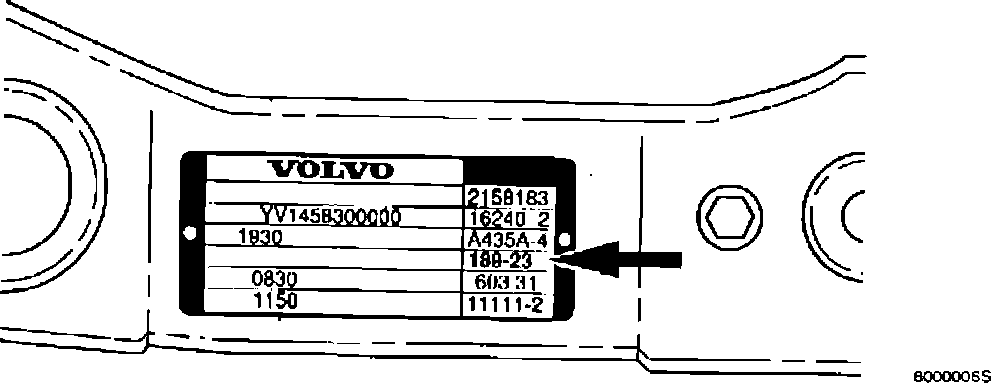
Cars with a base-solid paint and clear lacquer finish are identified by the number "3" as the fifth digit of the paint code. For example, color No. 189 is represented by the code 189-23. The delivery code - in this case "2" - may vary.
What is a base-solid paint and clear lacquer finish? The finish consists of two coats - a base coat of matt paint with a coat of clear lacquer on top.
WARNING:
Protective equipment should be worn at all times.
Paintwork repair
The procedure for surface preparation, priming, filling and intermediate coat application is the same as when painting with an ordinary solid paint.
Finishing with base-solid paint and clear lacquer
Procedure
Volvo's base-solid paint and clear lacquer is a two-coat finish consisting of a coat of base-solid paint protected by a two-component clear lacquer. The finish offers excellent gloss retention and color permanence.
See information from the appropriate supplier for working specifications of the base-solid paint.
Stir paint thoroughly before commencing work. This is essential to minimize the risk of color mismatching.
Dilute paint to correct spraying viscosity
Use prescribed thinner. Other thinners may cause uneven finish.
Note:
Always paint a sample to check the color before touching-up with base-solid paint.
Spraying viscosity: flow cup, 4 mm/20~C.
Adjust spray gun
Correct adjustment of the spray gun is important when applying paints.
Use 1.3-1.5 mm nozzle and spray, it pressure of 300-500 kPa (43.5-7-.5 lb/sq.in.). Incorrect nozzle specifications may make it impossible to achieve correct shade.
Poor atomization caused by incorrect nozzle size will produce large droplets and cause excessively "wet" (dark) application.
Excessive coating thickness may promote uneven finish.
Spray on first coat at normal rate of application
Allow paint to dry to matt appearance
Note:
There is a risk of uneven finish if drying time is too short.
Spray on second coat at reduced rate of application Increase spraying distance. Thickness of coat should be 15-25 micron meter following second application. (Shade will be stronger if second coat is too heavy.)
Allow paint to dry naturally (in ventilated area) for approx. 15 minutes
Note:
Paint finish may become uneven if clear lacquer is applied before base coat is completely dry.
Apply two coats of clear lacquer, ensuring even coverage
Wait 3-4 minutes between each coat.
Coating thickness: 40-45 micron meter
Dry clear lacquer
Drying time/component temperature:
12 h/20~C/68~F
30 min/80~C/176~F
45 min/60~C/140~F
Dry clear lacquer (with heating lamp)
If heating lamp is used, it must be positioned at right-angles to surface to be dried, to ensure uniform heat distribution.
Component temperature 70-80~C/158-175~F
Lamp distance 30-40 cm (11-15 in.)
Drying time 15 min