Removal and Replacement
Changing brake fluid
Changing brake fluid, general
When should the fluid be changed?
It is recommended that brake fluid is changed every other year. In the event of heavy and frequent braking, such as mountain driving or in tropical climates with high humidity, the brake fluid must be changed every year.
Why change?
The brake fluid is hydroscopic, i.e. the fluid absorbs water molecules from the air. This occurs via the brake hoses and the brake fluid reservoir, which is made of rubber and plastic, and is not impervious to water molecules.
High water content lowers the brake fluid's boiling point greatly, and causes corrosion in the brake system.
This damages the brake system, and reduces the braking effect.
Note! Use only Volvo Genuine brake fluid (minimum) DOT 4+. Never reuse brake fluid. Always keep brake fluid in its original packaging and well sealed.
Preparations
It is recommended that a bleed system is used.
Use a collecting bottle with a transparent hose to collect the brake fluid.
Connecting the bleed unit
Connect the bleed unit to the brake fluid reservoir. Follow the manufacturer's instructions for connecting and use of the unit.
Changing brake fluid
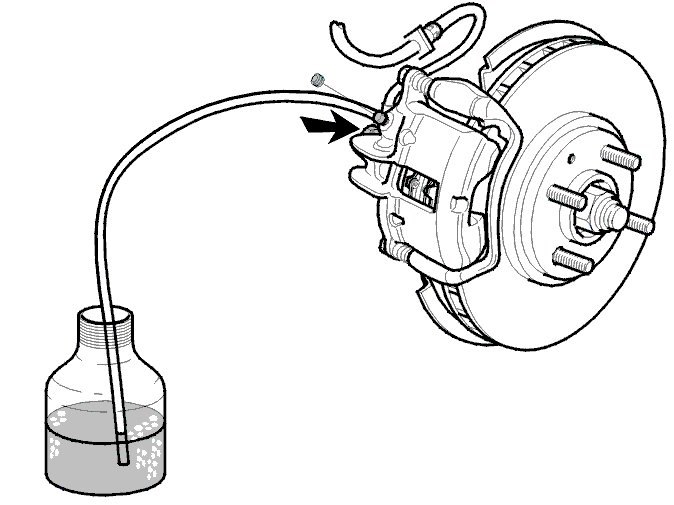
Remove the protective cap from the bleed nipple and connect the transparent hose to the collecting bottle. Open the nipple approximately one turn.
Pressurize the braking system with the bleeding unit.
Drain 0.2-0.3 liters of brake fluid.
Close the bleed nipple and remove the hose.
Tightening torque: 5 Nm.
Install the protective cap.
Slowly fill the brake fluid reservoir.
Slowly depress the brake pedal several times.
Order of replacement
Carry out bleeding/replacement in the following order.
- Rear right
- Rear left
- Front right
- Front left
Checking the brake system after replacement
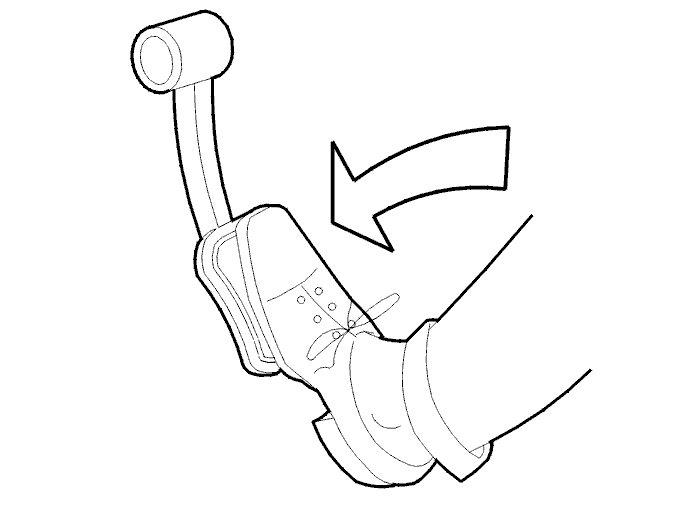
Remove the bleeding system.
Check if there is any remaining air in the system by depressing the brake pedal with the same force as when braking normally.
The pedal must not move downwards more than 40 mm when the engine is switched off, and after the brake pedal is depressed 3-4 times. Bleed again if the pedal's movement exceeds 40 mm.
Check the brake system. Check for leaks.
Check the brake fluid level.
Wipe up any spilled brake fluid.