Fuel System, Checking For Leaks
Fuel System, Checking for Leaks
Special tools, testers and auxiliary items required
• Fuel system tester (smoke tester) (KLI 9210)
• Hose adapter (KLI 9210/55-1)
• Vehicle Diagnosis, Testing and Info. System (VAS 5051B), (VAS 5052) or (VAS 5053)
• Hose clamps up to 25 mm diameter (3094)
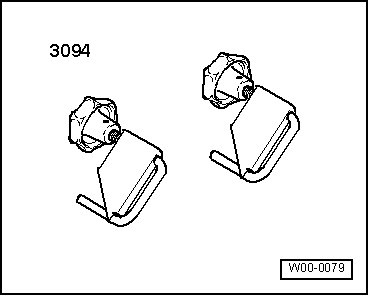
Test conditions:
• A leak was detected by Leak Detection Pump (LDP) (V144).
• Guided fault finding was performed with Vehicle Diagnosis, Testing and Info. System.
Evaporative Emissions Tester (KLI 9210) preparation:
• Depending on the version, the appearance of the Evaporative Emissions Tester (KLI 9210) may vary.
- Check on Evaporative Emissions Tester (KLI 9210) whether there is enough fluid in the smoke generator.
- Set valve - D - to "Hold".
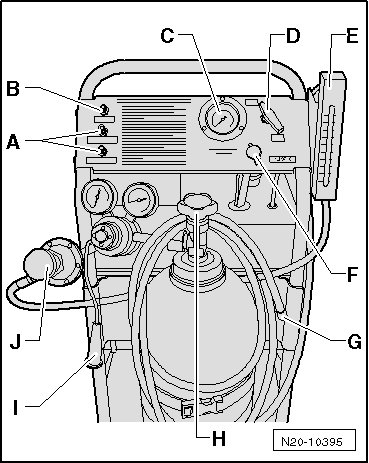
- Open nitrogen bottle - H -.
- Connect measuring hose - G - on self-test connection - B -.
- Set valve - D - to "Test".
- Using a pressure reducer - J -, adjust the pressure to 10 in. H2O (25 mbar).
- Set valve - D - to "Hold".
- The pressure must now be maintained min. 2 minutes. If the pressure is not maintained, check the tester.
Fuel system, checking for leaks:
- Connect Adapter Hose (KLI 9210/55-1) to ventilation line - A - as shown.
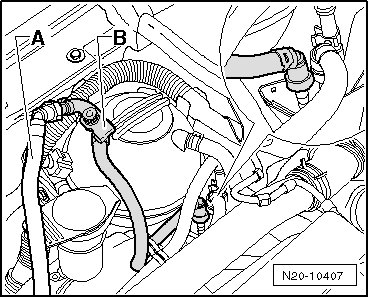
- Connect measuring hose - G - on Evaporative Emissions Tester (KLI 9210) to Adapter Hose (KLI 9210/55-1).
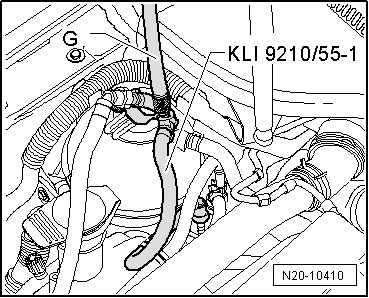
- Set valve - D - to "Hold".
- Connect evaporative emissions tester to vehicle.
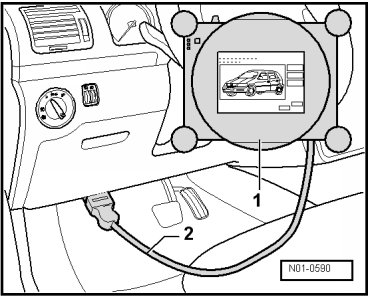
- Start engine and run at idle speed.
- Select Gefuhrte Funktionen operating mode on evaporative emissions tester.
- Select "Check tank ventilation system for leaks" guided function.
- Activate test.
- While the test runs, observe pressure gauge on Evaporative Emissions Tester (KLI 9210).
• The leak detection pump (LDP) (V144) must pump the fuel system pressure up to at least 7 in. H2O (18 mbar).
The minimum pressure is not reached, but the pressure reached does not decrease:
- Switch ignition off and perform pressure retention test. If no decrease in pressure is observed: Check the leak detection pump (LDP) (V144) vacuum supply => [ Leak Detection Pump, Checking Vacuum Supply ].
The minimum pressure is not reached and the pressure reached decreases immediately:
- Clamp off hose to Evaporative Emission (EVAP) Canister Purge Regulator Valve (N80) with hose clamp.
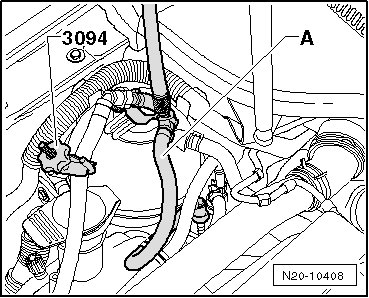
- Repeat the test. If minimum pressure is not reached: Replace Evaporative Emission (EVAP) Canister Purge Solenoid Valve 1 (N80).
The minimum pressure is not reached again and the pressure reached decreases immediately:
- Leak in fuel system, perform "leak test in fuel system" => [ Fuel System Leak Test ].
If the minimum pressure is reached, switch ignition off.
The valve in the Leak Detection Pump (LDP) (V144) is now closed and the pressure is maintained.
- Observe pressure gauge:
If the pressure does not decrease, perform a pressure retention test to locate any possible pinhole leaks.
If the pressure decreased, clamp off hose to Evaporative Emission (EVAP) Canister Purge Regulator Valve (N80) with a hose clamp.
- If pressure now no longer falls, replace Evaporative Emission (EVAP) Canister Purge Regulator Valve (N80).
If the pressure still decreases, perform "leak test in fuel system" => [ Fuel System Leak Test ].
Pressure retention test
- Set valve - D - to "Test". Increase the pressure up to 10 in. H2O (25 mbar).
- Observe the pressure gauge - C - and flow meter - E -. The fuel system is filled if the flow quantity decreases and the pressure increases to 10 in. H2O (25 mbar).
• Depending on the level in the fuel tank, this procedure may take up to 3 minutes.
- After the pressure has stabilized, set valve - D - to " Hold".
• After 5 minutes the pressure must not drop below H2O (20 mbar) drop.
If the pressure is not maintained for 5 minutes, the leak should be localized as follows:
- First check Evaporative Emission (EVAP) Canister Purge Regulator Valve (N80) for leaks. Clamp off hose to Evaporative Emission (EVAP) Canister Purge Regulator Valve (N80) with hose clamp.
- Repeat pressure test by resetting valve - D - to " Test".
- Observe pressure gauge and flow meter. The fuel system is filled if the flow quantity decreases and the pressure increases to 10 in. H2O (25 mbar).
- After the pressure has stabilized, set valve - D - to " Hold".
- If pressure now no longer falls, replace Evaporative Emission (EVAP) Canister Purge Regulator Valve (N80).
If the pressure still decreases, perform "leak test in fuel system" => [ Fuel System Leak Test ].
After completing the work, perform "Check tank ventilation system for leaks" guided function using.
Fuel System Leak Test
Test conditions:
• Procedure for "Checking fuel system for leaks" performed => [ Fuel System, Checking for Leaks ] Fuel System, Checking For Leaks.
• Evaporative Emissions Tester (KLI 9210) with Adapter Hose (KLI 9210/55-1) connected to vehicle
- Connect Evaporative Emissions Tester (KLI 9210) to vehicle battery.
- Remove rear right wheel housing liner.
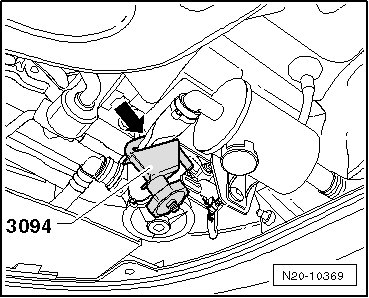
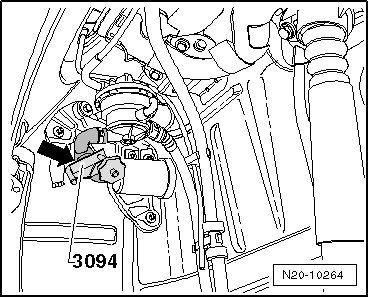
- Clamp off hose between Leak Detection Pump (LDP) (V144) and air filter - arrow -.
Eos
Rabbit
- Set valve - D - to "Test".
- Observe the pressure gauge - C - and flow meter - E -. The fuel system is filled if the flow quantity decreases and the pressure increases to 10 in. H2O (25 mbar).
- After the pressure has stabilized, set valve - D - to " Hold".
• After 5 minutes the pressure must not drop below H2O (20 mbar) drop.
- If the pressure no longer decreases, replace Leak Detection Pump (LDP) (V144).
If the pressure is not maintained for a minimum of 5 minutes or if no pressure is built up, localize the leak as follows:
- Fill fuel system with smoke by setting valve - D - to " Test".
- While fuel system is being filled, press smoke generator button - I - for approximately one minute.
The fuel system is now under pressure and filled with smoke.
- Check all fuel system lines and hoses for escaping smoke. Also check fuel tank sealing cap.
• Illuminate components and hoses with a strong flood light, the smoke will be more visible.
• To check for leaks at accessible locations, also use ultrasonic measuring device or commercially available leak detection spray.
• Depending on how long fault finding lasts, smoke generator button may have to be pressed again. This ensures there is enough smoke present in the fuel system.
• To check fuel pump and fuel filter flange, the assembly openings in the vehicle interior must be opened.
- Replace leaking hoses or components.
After completing the work, perform "Check tank ventilation system for leaks" guided function using.
EVAP System, Function Overview
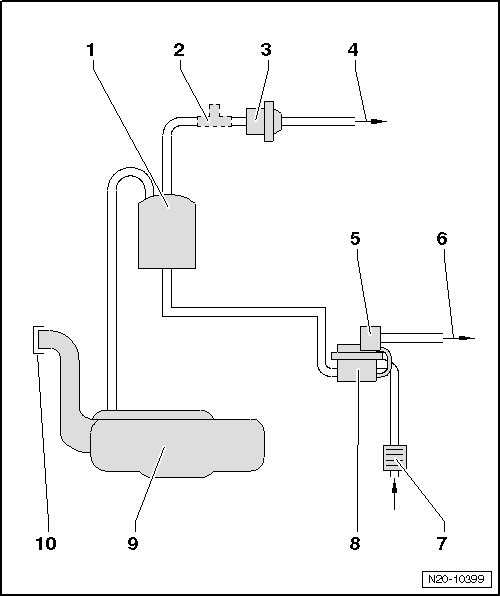
1 EVAP canister
2 Adapter Hose (KLI 9210/55-1) installation location
• with leak test in fuel system
3 Evaporative Emission (EVAP) Canister Purge Regulator Valve 1 (N80)
4 Vent line
• Throttle valve control module (J338)
5 Solenoid valve
• for Leak detection pump (LDP) (V144)
6 Vacuum line
• to Intake manifold
7 Air filter housing
• for Leak detection pump (LDP) (V144)
8 Leak detection pump (LDP) (V144)
9 Fuel Tank
10 Cap
Leak Detection Pump, Checking Vacuum Supply
Special tools, testers and auxiliary items required
• Turbocharger tester (V.A.G 1397A)
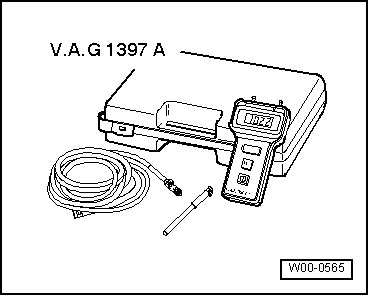
• T-piece (251 201 346)
• Hose dia. 6mm
• Leak Detection Pump (LDP) (V144) installation location
• Rabbit: Under wheel housing liner in right rear wheel housing.
• Eos: Behind right rear wheel.
Rabbit:
- Remove rear right wheel and wheel housing liner.
- Remove vacuum line - 1 - from Leak Detection Pump (LDP) (V144).
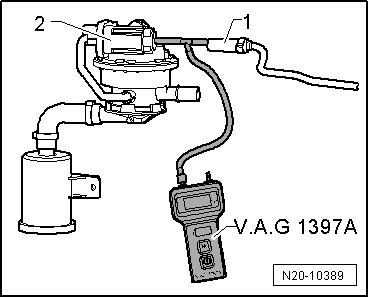
- Connect Turbocharger Tester (V.A.G 1397A) with T-piece and dia. 6 mm hose between vacuum line - 1 - and Leak Detection Pump (LDP) (V144) - 2 -.
Eos:
- Remove vacuum line - 1 - from Leak Detection Pump (LDP) (V144).
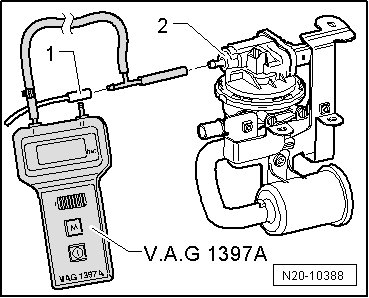
- Connect Turbocharger Tester (V.A.G 1397A) with T-piece and dia. 6 mm hose between vacuum line - 1 - and Leak Detection Pump (LDP) (V144) - 2 -.
All vehicles:
- Switch on measuring range I (absolute pressure measurement).
- Connect vehicle tester and start engine.
- Select Gefuhrte Funktionen operating mode on vehicle diagnostic tester.
- Select "Check tank ventilation system for leaks" guided function.
- Activate test.
- While the test is running, observe display on Turbocharger Tester (V.A.G 1397A).
• The pressure must pulsate and must not rise above 0.700 bar (absolute pressure) during the test.
- If the pressure rises above 0.700 bar during the test, the vacuum supply is too low. Check vacuum line to intake manifold for kinks or blockages.